From THE CITY OF OXFORD HIGH SCHOOL MAGAZINE VoL. LVIII, ii April 1966 no 185
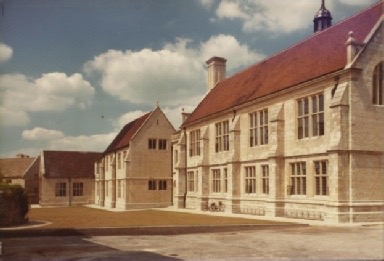
Ian Taylor writes:
In December 1956 the MAGAZINE contained an article on Thomas Graham Jackson (1835-1924), the architect of our School, and a further account was envisaged bearing more closely on his work in Oxford and his introduction of a stone sent from Rutland by water as far afield as Cambridge and Windsor for five hundred years. In Oxford local stones abounded: the random rubble of the city walls and St. Michael’s tower has survived for almost 900 years, yet the variable nature of the Headington stone used for facing seventeenth and eighteenth century buildings has led to expensive repairwork since. Even the laynton stone brought for centuries from the quarries near Burford by water to the stage or hythe at Hythe Bridge was substituted for by inferior altern- atives. The famous Bath stone which flowed into Oxford by the canal network of southern England for use in Regency Beaumont Street and many Colleges which were extended or refaced has proved uncertain in its lasting qualities. But thanks to Jackson’s “discovery” of Clipsham, an inferior oolitic limestone from Rutland, Oxford has been and is being transformed—at no time more rapidly than the present. Unfortunately, the original variety of textures is being replaced by one durable and, in some contexts at least, too harsh a material.
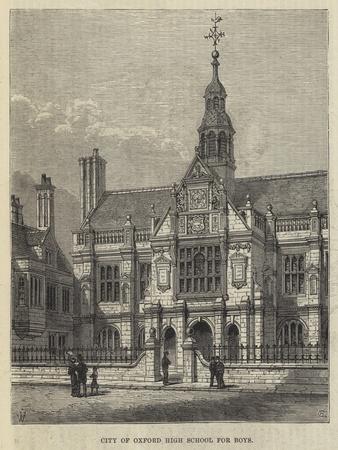
The Proposed School Frontage – the building to the left is the Headmaster’s Lodgings – which were never built
The Examination Schools ‘made’ Jackson and Jackson ‘made’ Clipsham. It was so successfully utilised for repairs to the pinnacles and upper stages of the Bodleian and on the High Street front and the court of the great Examination Schools between 1876 and 1883 that its hard-wearing qualities became recognised. But in another form the stone gained popularity; Jackson, breaking with the tradition of University and College building of the previous three centuries, reintroduced the medieval combination of local walling stone with freestone dressings in the back of the Examination Schools, in the Boys’ High School, and soon after at Exeter, Brasenose, and Trinity. The local stone was the Forest Marble from Bladon which had, in all fairness, been used already in a few Oxford buildings like the Chapel at the Radcliffe Infirmary with Doulting stone dressings from Somerset. This was the combination used at Trinity for the front Quadrangle (1883-87) but for the others it was Bladon and Clipsham for the dressings except in the notable case of the High School (1880-81). He reverted to these two stones for most of his later work, e.g. at Hertford for the Chapel and the new block over the bridge (1903- 31).
At this point it would be worth recalling the specifications made in the resolutions of the Board of Governors on January 28th, 1879.
- “That it is desirable that the principal School Room should be capable of accommodating 400 boys seated in assembly.
- That the room for this purpose should be 30 feet by 90 feet in the clear it was afterwards reduced to 27 feet by 81 feet].
- That there should eventually be 12 class rooms capable of accommodating 30 boys each.
- That each class room should not be less than 22 feet by 21 feet.
- That the design for the building should be so arranged as to provide at first only the large room and four class rooms underneath and that the ground floor be raised well above ground level. £2,500.
- That the design include a Head Master’s residence to cost £2,500.
- That the necessary offices should be provided for the School.
- That the principal elevations should be of Charlbury or other approved stone with Bath stone dressings.
- That the following architects be invited to send in drawings:
- Mr. Codd [who eventually received 3 votes]
- Mr. Jackson [who received 8 votes]
- Mr. Wilkinson [whose plans were put aside as not having complied with the instructions].
- That the Town Clerk give the Architects to understand that the Governing Body do not expect to be able to spend more than €10,000.”
At a later meeting Broseley tiles were specified for the roof.
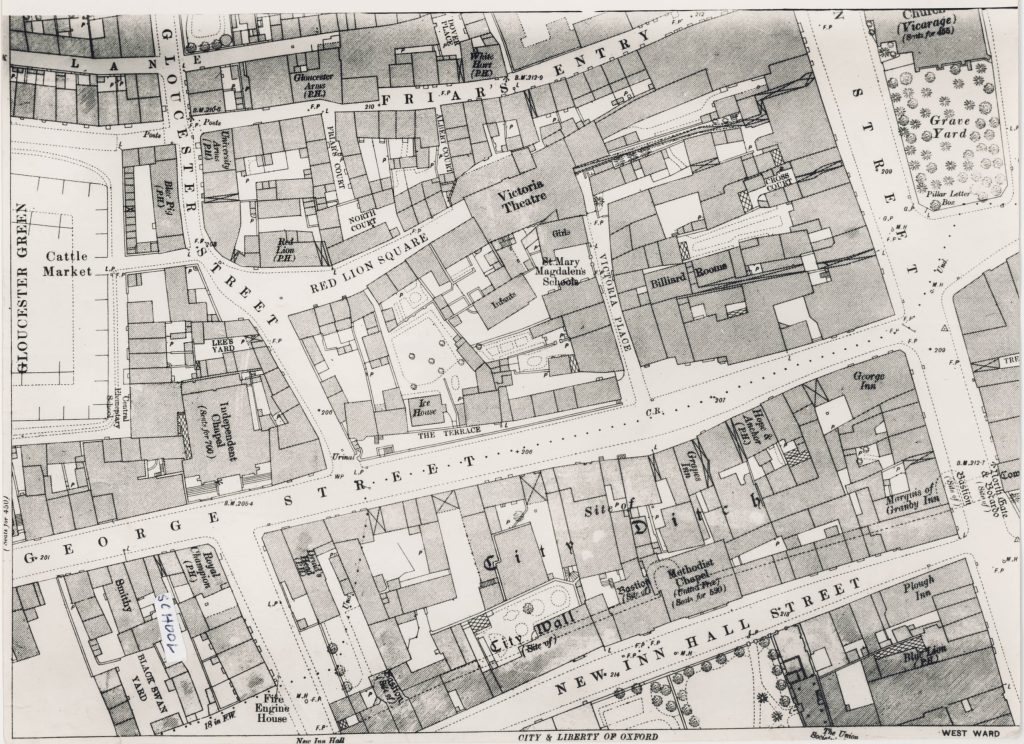
It was clear that the Governors knew what they wanted and intended to give the High School the best building their money could buy. The site had already been given by the Corporation. The gift of the old stone of the City Gaol in Gloucester Green was realised for £170 cash rather than use it. Eight tenders ranging from £8,482 to £7,480 were received; the lowest was accepted from Mr. Charles Claridge of Banbury, to include the Hall, the four classrooms beneath and the two stairways. There were a number of extras to be added including £100 for the carving to the front of the Portico. The Head Master’s house was not proceeded with and Mr. Pollard took boarders in Bradmore Road It was a number of years before the initial overspending was paid off.
By some error, the late W. J. Arkell has stated on page 28 of his authoritative Oxford Stone (1947) that Clipsham and Bladon stones were first used at the Examination Schools and the Oxford High School. By a strange coincidence Arkell could hardly have known about, Jackson wrote urging the use of Clipsham dressings. At the Governors’ meetings of both September 27th and October 22nd, 1879, the request was turned down—’it was resolved that Box Ground stone should be used as fromerly.’
There was a sequel to this. When in 1894-95 Jackson was asked to build the first two rooms (one up and one down) of the original proposed extension, he employed Bladon walling with Clipsham dressings and mouldings. Again, when in 1914-15 Benfield and Loxley added three more classrooms and the new laboratories (at a cost of f4,555), the same combination was used.
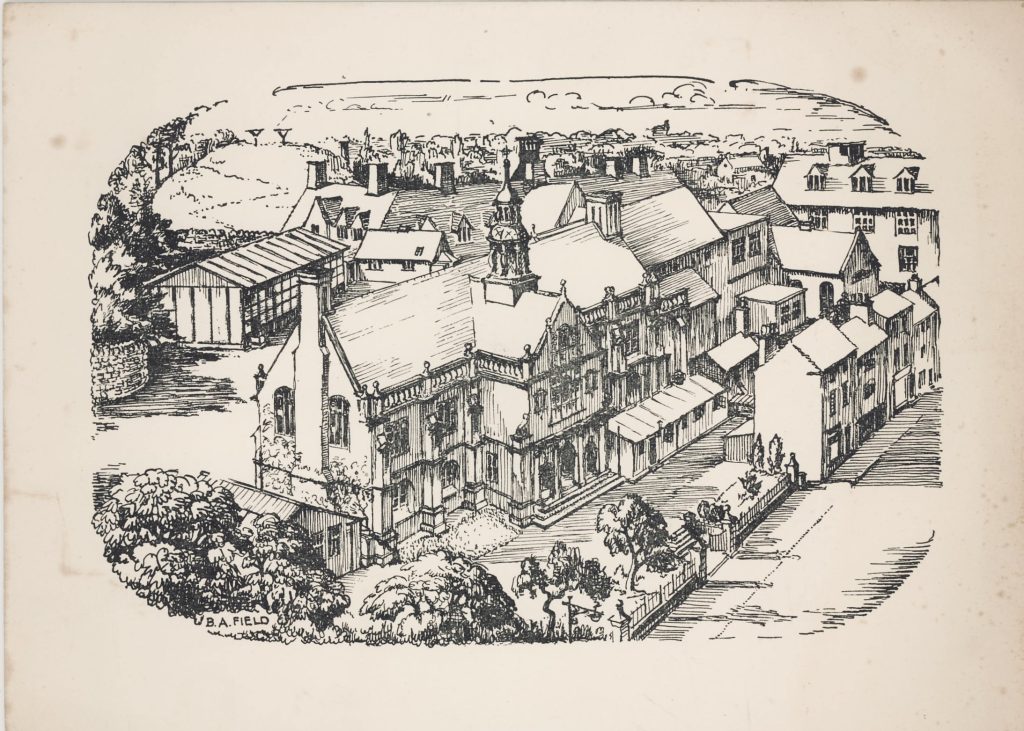
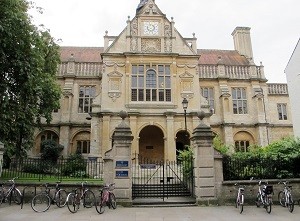
At a recent inspection by Mr. John Edney, a retired stonemason, the stones of the portico were identified as Headington hard- stone for the plinth, hammer-dressed Bladon walling with Box Ground mouldings and dressings, whilst the steps (like the paving inside) are of Portland. He was of the opinion that the four piers and the arches and all the carved stone above were of Corsham Down, a finer-grained stone quarried but three miles away from Box whose product Arkell calls ‘the best and most celebrated of all Bath stones’. Elsewhere the walling is of Bladon stone with dressings and mouldings of Box, which is also used for the large foundation stone in the middle buttress of the south side. There is certainly some Bath stone in the buttresses, which contain Bladon with some large soft stones, the latter perishing badly. The Bath stones can be picked out by the vertical veins of calcite they usually contain.
It seems strange perhaps that Jackson in his Recollections edited by his son Basil and published by Oxford University Press in 1950 makes no claim to have introduced Clipsham stone to his Alma Mater. However, this autobiography was not intended for publication and when it was penned in the early years of the century it is possible the full value of the stone was not apparent. B. H. Jackson in a letter to the writer in 1959 says he remembered his father saying that ‘on one of his visits to Clipsham he remarked on the large amount of stone that had been quarried and the reply was “well, you know, you’ve had most of it”! To quote Arkell, again, ‘these two stones, Bladon and Clipsham, are the only ones making any contribution to Oxford at the present time. This remark is almost as true now as it was when it was written twenty years ago and one likes to give credit to the foresight and energy of ‘Oxford Jackson’ (as he was nicknamed at one time) for employing new ideas, new materials, and new methods in an Oxford still in the grip of the gothic revival. Many other architects since, beginning with Sir Herbert Baker with Rhodes House in 1929, have used this combination.
THE MOTTOES
The motto Nemo repente sapit (no one suddenly becomes wise) has been in constant use as the School motto ever since 1927.
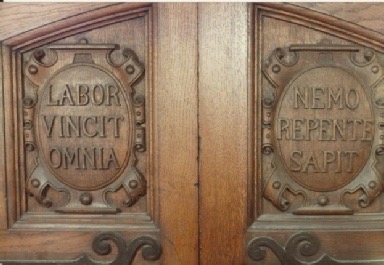
In the Governors’ minute book under the date May 19th, 1881 the working party, remembering the School’s chief benefactors, advise the mottoes of the City and University Fortis est veritas and Dominus illuminatio mea be placed on the tablets facing George Street’. In a letter from his office in the Temple dated the same day and read at the meeting on May 25th the Architect wrote ‘the Contractor will shortly require to move his scaffold… May I therefore suggest as the second motto which appears appropriate to the building? If the Governing Body approve, I should be glad to have this cut at once. I hope to send Alderman Hughes a drawing and an estimate for the clock face shortly.’ Resolved… the question of the motto had already been settled. Perhaps we are left wondering which the other motto was. But Jackson’s enthusiasm was not easily turned aside and before the School opened on September 15th, 1881 there 48 were carved on the panels of the front door, plain for all to see, Labor vincit omnia and Nemo repente sapit (see the illustration in the Magazine for July 1965).
With due deference to a School Song neither of these mottoes appears classical but both seem derivative. Chaucer’s Prioress carried a brooch on which was graven Amor vincit omnia. Omnia vincit Amor et nos cedamus Amori, writes Vergil in the Eclogues, and Labor omnia vicit improbus, in the Georgics. We find Nemo repente fuit turpissimus in the Satires of Juvenal but Nemo repente sapit has an Ovidian ring, too. We may perhaps conclude that Tackson’s classical scholarship (he read Greats) well enabled him to compose a tag of his own.
THE STONE-LAYING
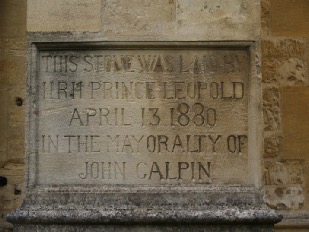
Graham Jackson delayed his honeymoon a fortnight to be present at the laying of our toundation stone on April 13th, 1880, by which time the walls had risen to a considerable height. The first of two letters quoted (by permission) from his Recollections is written from Wadham College (of which he had been a Scholar and a Fellow) on the very morning of the ceremony:
‘… We came here yesterday and are staying with the Warden, who gave a dinner-party yesterday in Alice’s honour. This morning we are to go to the laying of the stone of my new High School for Boys by Prince Leopold, after which there is a luncheon in the Town Hall and then we shall at last be free to take wing for Rome, not staying for the party in Christ Church Hall to which we have been invited by the Liddells to meet Prince Leopold. Tonight we hope to sleep at Calais…’
And then from Genoa dated April 18th:
‘… I wrote to you last from Wadham on the eve of the great ceremony. The fine day made it go oft well, for which I was glad, tor these occasions, dull always, are doubly dull when it rains. However, it was warm and summerlike and there were crowds of people, and I had not to make a speech and so I was very well satisfied with the event. The invited guests of whom I was one met in the courtyard of the Town Hall and then were marshalled two and two, the Doctors being in their scarlet and black velvet and the Town Councillors in scarlet and fur, into the Corn Exchange [behind the old Town Hall] where stood the Prince with the Mayor, who presented us in turn. After that we marched, two and two, through the streets which were lined with people to the site…’
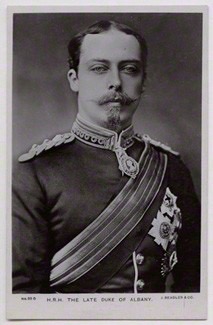
The site was crowded with people. The Prince and the Mayor were on a small raised space surrounded with flowers in pots, close to the stone which was poised in mid-air… There was a short service by the Bishop and then I handed the Prince his silver trowel, and put the bottle into its place under the stone and a bricklayer brought a board of mortar. The Prince wanted to know where he was to put it, and I said I thought anywhere, but a more sagacious bricklayer suggested that he should put a a little on each corner, which he did, and walked diligently round stone for the purpose. There was a luncheon afterwards in the Town Hall and then speeches, which Alice and I escaped, having to run away to catch the 4.10 train ….
I.H.Taylor