From THE CITY OF OXFORD HIGH SCHOOL MAGAZINE VoL. LVI, ii March 1964 no 180
From Ian (Spud) Taylor
The Reformation had led to the establishment of grammar schools in many sizeable towns in England but not in Oxford. Wolsey, who had bestowed such liberality on Christ Church, had preferred to build a school in his native Ipswich. Yet, as time went on, it became apparent that neither Magdalen Grammar School, incorporated as it was within the walls and community of the College, nor the choir schools of New College and Christ Church by concentrating on their primary purpose were meeting the needs of many local boys.
Even in 1576 a school was mooted but it remained unfounded till the Commonwealth when, on April 19th, 1658, Alderman John Nixon settled a free school for forty boys, the sons of poor freemen. They used the Council Chamber till their school was completed later in the same year on land in the yard at the rear of the Guildhall which the Corporation granted to Nixon for 1,000 years at a nominal rent.
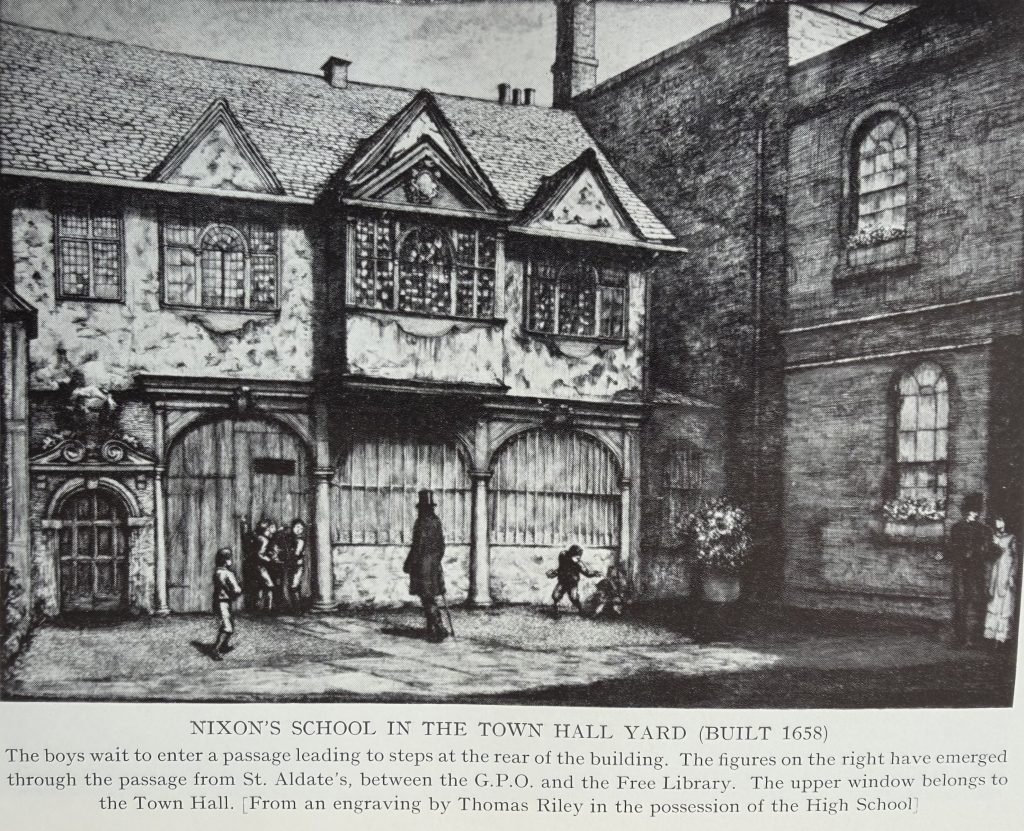
The elegant little building propped up on three semi-circular arches with its leaded lights and gable windows was approached by a staircase from a doorway which once proclaimed its foundation in letters of gold. In due course the medieval Guildhall was replaced by a Georgian Town Hall but the building survived till the site was cleared for the erection of the present Town Hall in 1893-97.
In January 1659 the founder granted to the Mayor, Bailiffs, and Citizens of Oxford £500 as purchase price of £30 a year for the salary of a schoolmaster. Soon after he added £205 to this capital. In the remaining few years of his life he took great interest in the selection of his beneficiaries and in the organisation of the School on practical and religious lines. Nixon was a native of Bletchington who became a successful mercer in High Street. He was a zealous and fearless Puritan, held in high esteem by Parliament for his activities and apparently by the Freemen of Oxford, who thrice voted him mayor. Anthony Wood in his Life and Times was not sympathetic to Nixon’s hard dealings, his political views, nor his malice toward the University from which he had made his fortune. His bitterness forbade ‘privileged’ men’s sons from entering the School. Thus all who served the University, however poor, were denied the Alderman’s charity.
He died in April 1662 aged 73 and his grave close to the south door in St. Mary the Virgin Church (whose Laudian porch opposite his house so scandalised him) is marked by a black slab:
… Twice 20 Free Schoole Boyes
Immortalize his Name.
His widow, Joan Nixon, set up a trust to pay the indentures of two boys annually as apprentices in the City. The trustees appointed by Nixon in his will and their successors administered the charity and elected the master and boys until 1862 when the Oxford Charity Trustees took over.
The regulations contained in the original agreement with the Corporation are so interesting in their detail that some of them are worth referring to.
The boys came at the age of 9 or 10 and could remain freely for seven years. The only charge was 12d. for the master on entering and 1d. periodically for candles. The need for these is accounted for by the school hours which were to be from 6 tọ 11 in the morning and from 1 to 5 or 6 in the afternoon. In winter school was to begin at 7 or 7.30. Thursday afternoon was to be a time of recreation. On Saturday afternoon the master was to catechise the scholars, and on Sunday morning and afternoon the boys were to repair to some church and to be able to answer questions on the sermons on the Monday morning. Every day began with prayers.
At all times the master was to have special care for the decent deportment of the scholars and he was to punish those who transgressed the normal code of conduct. The master was to ‘apply himself to teach all the Boys first to Read then to Write and cast Accompt well and afterwards if they be not removed to teach them the knowledge of the Latin Tongue so far at least as that they may be fit to be Apprentices in any Calling whatsoever’.
The School was unusual in that sons of master tradesmen and others who had served their apprenticeship alone were admitted. No doubt these men made up half of the adult male population (neglecting the masters and scholars of the University) but such was the political state of the time and such was the memory of the University’s all too recent loyalty to Charles I that privileged men’s sons were excluded.
The School aimed higher than many in setting out to teach Latin to the older boys at least and thus it could rightly claim the rank of grammar school. In the years that followed the School’s fortunes waxed and waned with the efficiency of the master. In 1716 an assistant was needed, but forty years later it was being ‘neglected’ and boys were leaving to join the Blue Coat School in St. Ebbe’s (founded 1710 and whose buildings were later absorbed into the City Technical School). This is not surprising considering the master’s salary was only £18 per annum.
In 1809 the free places were fixed at 30 and no Latin was being taught, yet in 1838 there were 40 foundation scholars once more and 25 pay-boys. Ten more free scholars were taken and Latin was taught again to the top class when the Freemen received compensation from the Oxford and Rugby Railway in 1845 for land in Port Meadow: A smaller sum was paid by the Bucking-hamshire Railway in 1850, and between these dates there was an abortive proposal to buy a site in St. Ebbe’s and transfer the School. From 1809 to the closing of the School the Corporation were granting f15 a year to supplement the master’s salary.
About 1840 the school hours were still long-from 6 a.m. to 4.30 p.m. with one hour for breakfast and two for dinner, from 9 a.m. in the darkest months, and from 7.30 a.m. in the intermediate period. Boys from Nixon’s and the Blue Coat Schools attended St. Martin’s Carfax twice on Sundays (the City church where the Corporation worshipped each week) and formed the choir. In Sunday school Nixon’s boys in consideration of wearing their best clothes were allowed to kneel on the forms instead of on the floor which two of their number were detailed to sweep daily.
Life was not without its compensations, for once a year the newly elected mayor entertained the boys of both schools to a piece of cake and a glass of wine in his Parlour. He also took trouble in placing leavers with the best establishments in the City.
The last master, the Rev. G. C. Bliss, M.A., who served the School for over thirty years, was paid f80 annually out of which he otten employed a pupil teacher. Once or twice he received an honorarium of f5 but it must have been a pitiful struggle. In 1oo2 the Oxford Charity Trustees were appointed permanent visitors and governors in place of the successors of Nixon’s trustees.
Although Latin was taught the school was classed as elementary and the building was in such poor repair that the Government Inspector of the Oxford Charities condemned the school as unfit for 60 boys. It was, he said, the worst he had ever seen.

Before the Post Office was moved across St. Aldate’s in 1879 it occupied the southernmost bay of the Georgian Town Hall, and business was done through two little windows in the passage leading to the Yard behind. When in 1870 telegraph systems were taken over trom private enterprise, equipment was centralised in the space under the School (which the Corporation claimed as their property. Very soon the Head Postmaster was complaining to Mr. F. J. Morrell, chairman of the Charity Trustees, of the practice of dousing the fire every night with water which seeped through on to the telegraph machines.
A New School
From 1873 there had been efforts to incorporate the failing Nixon’s School in a new Grammar School worthy of the city.
‘It has long been felt a reproach to the City of Oxford that… it has been absolutely without any recognised grammar school for the sons of its citizens… The sense of this reproach has become keener of late years’
– so runs the public appeal of 1877. numerous freemen in the Council combined against the project, for it was something novel to consider spending public money on such a scheme – the compulsion only came with the Act of 1902.
Early in 1878 a public meeting was held which came close to disaster, but from it the High School was born, though not, as was hoped, incorporating the poor Freemen’s School. The need for a day school to provide a good liberal and practical education between the elementary schools and the University was as much required by the citizens as by the young dons who were now enabled to marry and live out of college in growing North Oxford. This project, as pointed out by Lord Salter writing about the origin of the High School in the first two numbers of the MAGAZINE in 1903 (qv), was the earliest in which City and University combined together for a common good. When T. H. Green died a few months after the School was opened, both elements had equal cause to mourn his death.
In 1881 the Charity Commissioners under the Endowed Schools Act agreed to a scheme whereby the Corporation offered a site in Worcester Street backing on to Gloucester Green and the sum of £1,000 for building purposes in exchange for the site in the Town Hall yard. Plans went forward but the modest scale of the proposed master’s house would have precluded a family man. Eventually the scheme was dropped and the Charity Trustees rebuilt on the site the Cutler Boulter Dispensary (which the High School used as an annex for several years).
The Battle between the Freemen and the Charity Commissioners
The freemen’s committee had applied delaying tactics to all schemes of removal or rebuilding. As a result, the Charity Trustees in 1883 applied to the Charity Commissioners in London for a scheme to close the School and to create an exhibition fund for both girls and boys at other established schools. The Commissioners expressed the opinion that the opening of the High School for Boys had largely met the wants of secondary education and that the establishment of a small school was uncalled for. The Freemen’s committee replied that it was an old foundation and anyway the scheme had been published after the founding of the High School. ‘Our Committee consider there is in Oxford ample room for a good commercial school..é. without clashing with any of the existing educational institutions.’
This decision was communicated to the Corporation through the Town Clerk on December 31st, 1883.
The will of the Commissioners, however, prevailed and secured the closing of the School. A Common Hall was convened for July 8th, 1885, to accept the suppression of the School and the end of the current term. This was only the beginning of further wrangling, the freemen claiming that they were being robbed of their ancient rights. In 1887 the freemen’s committee boasted: ‘they have hitherto successfully prevented the scheme of 1885 from passing into law; and although they have been unable to prevent the School from being closed and the provisions of the scheme to a certain extent anticipated, they have strongly protested….’
They had been claiming all the proposed Nixon’s exhibitions but they had to be satisfied with absolute right to half only and to be able to compete with the sons and daughters of others for the remainder in the new scheme.
Their other stratagem was to re-form the School for boys on an annual income of only £190, to be made up by a further f40 by taking 20 pay-boys at f2 per annum. ‘Your committee believe they can see their way to making Nixon’s School thus re-estab-lished successfully fulfil its founder’s expressed intention.’
This piece of transparent humbug genuinely reflects the attitude of far too many people at the time that the needs of education could be run on a shoestring. Perhaps the committee knew it had no chance of success in its demands but had resolutely dug its toes in.
Although the motion was carried by a large majority in a Common Hall in 1887 nothing seems to have come of it. Instead, by a scheme which received the Royal Assent on October 17th, 1894, the income of the foundation – plus £50 annual compensation from the Corporation for the loss of the site – was ordered to be applied to the payment of Nixon’s exhibitions. Thus ended a pertod in which the freemen’s committee fought stubbornly to the last.
The story of Nixon’s School covers at its beginning and end periods of intense political activity, the intervening period being comparatively lethargic. It extends over the time at which education was hard to come by (and then usually through the help of charity) to the later Victorian era when education was compulsory but free only in the elementary school. Many an Oxford boy and girl in the last seventy years has had cause to be grateful for the exhibitions which were tenable at the High School and other schools above elementary level, when the fees of a few pounds a term were beyond their parents’ means. The 1944 Act abolished fees but the money is still used by the Trustees for educational purposes.
I. H. Taylor