From THE CITY OF OXFORD HIGH SCHOOL MAGAZINE Vol LIV,ii April 1962 no 174
F. C. (Fred) Lay, Old Boy and then Headmaster, writes:
Although T. H. Green was recognised by his contemporaries as playing a large part in the founding of the School it is surprising that we have never reproduced in the Magazine a copy of either of the two portraits which are so well-known to all who have been here, nor has any account been given in these pages of what this remarkable man was like.
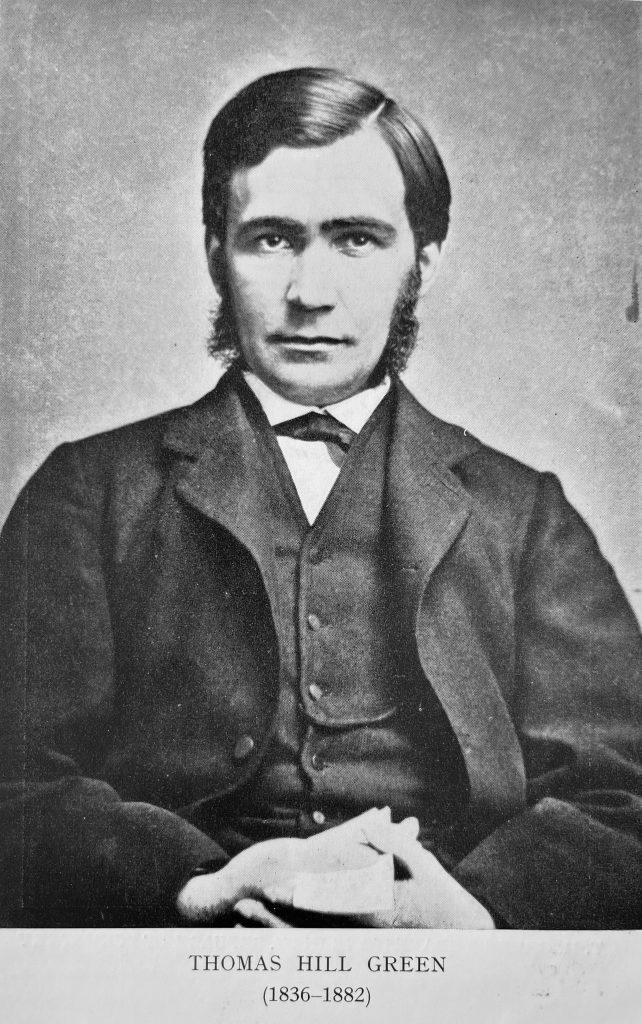
It is now just eighty years since he died: eighty years of rapid development in a field which he surveyed for us and left us to cultivate. Whether or not he was responsible for founding the new school that became the Oxford High School for Boys, there is little doubt that the form it took received much direction from his enthusiastic interest. Lord Salter in the second of his two articles on the History of the School (Vol. 1, no. 2 p. 29) quotes Dr. Harper, the Principal of Jesus, as saying ‘ the movement for the establishment of the school first took definite and tangible shape at a little quasi-social party in a dining room in Norham Gardens at which gathering T. H. Green was present.’
The host was Mr. Hawkins, the Town Clerk, who undoubtedly had much to do with the initial details of the scheme but Thomas Hill Green was in any case a valiant champion of it, both by inclination and experience. He had been on the Governing Bodies of Firth Park School, Sheffield, of Wyggeston School, Leicester and of King Edward VIth School, Birmingham. His membership of the Education Commission in 1864 had made him an authority on current problems as a result of his personal inspection of schools in the Midlands.
For the great part of our knowledge about him we are indebted to the Memoir of his university pupil, R. L. Nettleship, Fellow of Balliol, who tells of the schemes he propounded for both Elementary and Secondary Education and of his work in influencing the whole pattern of middle-class education. He was, therefore, an obvious ally to 31 enlist, and clearly a most willing one, when the question of secondary education in Oxford was becoming acute, and when well-to-do citizens who could afford university fees found that there was no day school available from which their sons could matriculate.
T. H. Green was born in the West Riding of Yorkshire at Birkin, a village where his father was Rector, on April 7th, 1836. He died at his home in Oxford on the 26th March 1882 before attaining his forty-sixth birthday. At the first Speech Day of the School on August 1st, 1882, the Mayor, as Chairman, lamented the removal from among them by death of one who took the very liveliest interest in its foundation and well doing. Yet during his all-too-short life he achieved a distinction and a fame in the sphere of education which were to leave their impress in a lasting way not given to many.
He was educated first at Rugby, and, in 1855, he entered Balliol where he had been offered a place after the Scholarship examinations. He had enjoyed his school-life, we are told, in an oddly shy kind of way. He played football regularly and ran in ‘ hare and hounds’, but more for the sake of his health, or from a sense of duty, or to avoid singularity, than because he liked it; but in the regular work of the School he seldom gained great distinction.
So often many boys who do not grow into intellectual men are stimulated to intellectual efforts by competitive impulse or by the simple pleasure of activity, but he was not impelled by either of these motives. A stronger reason for his apparent want of success was the fact that his heart was not in the subjects in which distinction at school is chiefly won. “He had indeed a genuine literary sense,.• but he needed the presence of something great to make him put out his strength?. This was shewn when he gained a prize for Latin Prose Composition with a version, in which he surpassed himself, even more than his competitors. In another competition he was successtul, greatly to his own surprise tor ne had ‘ to consult a variety of fusty authorities which can never succeed in doing well: I find that when I cram myself with the ideas of others, my own all vanish.’
Herein, perhaps, is seen the key to his character and this love of mental independence stayed with him throughout. He prophesied to his father in a letter home, “The reason why most people think me idle is that I cannot think it right to devote myself to the ordinary studies of school and college, which to me are of very little profit: and hence the fruits of my labour do not at present appear, but I hope that they will do in time”. At any rate he possessed that all-important attribute of knowing himself.
Nettleship goes on to tell us that his undergraduate career was a repetition of his school days. Thus his second class in Honour Moderations was rather what he knew would happen, but it was followed by the brilliant First in Greats which everyone hoped of him. After his degree he stayed on at Balliol as a lecturer at the earnest recommendation of his tutor Benjamin Jowett. He later became Fellow and Tutor of his College but in 1878 he was elected to be White’s Professor of Moral Philosophy. The Dictionary of National Biography refers to him as an assistant-commissioner on middle class schools in 1865, benefactor of Balliol College and the Oxford High School and founder of a university prize, and as the original of ‘ Mr. Grey’ in Mrs. Humphrey Ward’s ‘ Robert Elsmere.’
His chief literary work, known to every student of philosophy, is his ‘ Prolegomena to Ethics’. Three other volumes edited by R. L. Nettleship, each of over 500 pages, include his hitherto unpublished philosophical papers in volume I and II. The third volume (Miscellanies) contains, besides the memoir of his life, some of what is, for us, the more interesting material of lectures delivered in his everyday capacity as citizen, Town Councillor, educational theorist and historian. Thus these papers range from criticisms of various philosophies to some of his Lay Sermons on Paul’s Epistles: studies on the English Commonwealth wherein he makes a study of Oliver Cromwell and the Protectorate (he was in fact connected with the Protector by descent and was a stout upholder of his ‘ Independent’ principles) and finally lectures in which he outlined, in the first, his scheme for the ‘ Grading of Secondary Schools ‘ , in a second ‘ the Elementary School system of England’ and in yet another and the last ‘ The work to be done by the new Oxford High School for Boys’. Nettleship says ‘ The proposed grammar school, or high school as it was eventually called, was of all public objects that in which he took the keenest interest and the one to which he gave the most material support.
When the scheme had taken practical shape at the end of 1877, he contributed £200 to the building and founded a yearly scholarship of £12 tenable at the School by boys from the Elementary Schools of Oxford: ‘ Whether his far-reaching view of what the new School might do for the town are destined to be realised, is still a question for the future’. He held the strong liberal views of the time, although not as an active party politician. It was as a social reformer that this party gave him the opportunities for putting his theories into practice. He had long felt the need for a proper room for political meetings and discussions rather than holding them in public-houses and this resulted in the building of the Liberal Hall.
He believed in temperance. He deplored that the phase of prosperity through which the country was passing since the great Liberal majority of 1868 merely meant to many that money and beer flowed freely, and the heavy defeat of the Liberal party in 1874 was, he told them, their own fault. He deplored party politics in local elections and he was, in fact, elected as a Councillor for the North Ward in 1876. It was the first time that a college tutor had been a town councillor and he was thereby laying the foundations of the bridge which spanned the gulf between City and University. Paddy and present members of the City of Oxford High School may well take note and be ready to bear testimony to the value of that bridge which they would regard now as a well-trodden thoroughfare.
His work for educational administration gave him, as we have already noted, the idea of how the High School should be shaped when he had the opportunity as a Town Councillor to have a hand report on Drose be pat sal mot indy needed in the commissions of 1858 and 1861. An assistant commissionership was offered him then through Dr. Temple and he accepted. His selected district was Warwickshire and Staffordshire and it was later extended to further counties. This work occupied him through 1865 and 1866 and entailed examining the policy and organisation of all the private, proprietary, and endowed schools for boys and girls in the area and testing their attainments by examination. He had to make a special report on King Edward’s School at Birmingham as being an important school to serve as an example.
The outcome of all this work resulted in a report which the commissioners hoped would have far-reaching effects. The quality of education, they found, was lamentably low. The schools were too small to have a volume enough to make higher work a possibility and the few boys of promise were being held back by the dead weight of ignorance in the junior classes— a view which has a strangely modern ring about it even now. But whereas they hoped that the Government would take steps to merge small schools into larger units in order to make higher work economically possible, they were doomed to disappointment, for the Endowed Schools Act of 1869 made no provision for the establishment of provincial authorities which could have power to deal with schools in groups.
Each school still had to be dealt with individually. They had gained nothing except that here and there where locally) it had become possible to classify schools in ‘grades’, the first grade feeding the second and so on up to five grades. His lecture on the ‘ grading of schools ‘ however bore fruit eventually in the scheme of 1878. The elementary schools (the first two grades) had progressed so well since the Forster Act of 1870 in Gladstone’s administration, that there was no need to divide the post-elementary section into three grades and in 1880-1881 the lower and middle schools were fused into grammar schools, leaving the top grade or ‘ high school” for those who contemplated staying on till 18 to go to a university.
We cannot here go into the full details of Green’s proposed organ-isation. Briefly he saw secondary education as based on a voluntary principle whereby those who did not wish to continue would leave the elementary school to become artisans or apprentices. Those who wished and who could afford to stay on should be taught some French or Latin at the Higher Grade Schools of which he noted Frides-wide’s School and the Wesleyan School. These would produce his outer ring of Grammar Schools. Finally none of these would have sufficient pupils to make it economically possible to include in the curriculum the study of Greek which he regarded as desirable for university entry, and therefore at the apex of his pyramid there would be a High School. Boys who were destined for the university, however, should not wait to be passed on from one school to the next since, if they were to learn Greek, they should begin it at the age of ten or eleven. The High School should therefore attract boys from that age and, where necessary, should provide scholarships or bursaries at private or public expense. These could be filled by boys of the age of ten or eleven from the elementary schools.
He endowed one himself. That the scheme began to work every-where is a tribute to his zeal. The pattern in Birmingham was held up as an example, and his co-workers on the commission, Dr. Harper and Dr. Dale, were his helpers later in Oxford. The former, who was Principal of Jesus and a former Head of Sherborne, became one of the fonder governors of the new school. It is a strange comment that when compulsory secondary education for all followed in the 1944 Act the generous extension of grammar school places by the State brought the term ‘eleven plus’ into such opprobrium.
T. H. Green did not survive to see the completion of the work for which he had striven. He died suddenly on March 26th, 1882.
What sort of a man was he?
We have the pen-pıcture ot hım ın Mrs. Humphrey Ward s novel ‘ Robert Elsmere’ written in 1888. The novel had a tremendous success in England and America; and the first three editions-amounting to 70,000 copies were soon sold out. It was dedicated to T. H. Green and Laura Octavia Mary Lyttleton and in it Green appears, in transparent disguise, as Mr. Grey.
Mrs. Humphrey Ward, grand-daughter of ‘Arnold of Rugby ‘ knew Green well and shared his interest in the liberalising movements of the day. She saw him through the eyes of her hero, Robert Elsmere, against the background of an Oxford College.
‘… And so Elsmere attended in one of the larger lecture rooms that night and found it already nearly filled with tutors and some of the more senior undergraduates. Then Grey entered and the scene was never forgotten in Elsmere’s mind. In after years memory could always recall to him at will the face and figure of the speaker, the massive head, the deep eyes sunk under the brows, the Midland acent, the make of limb and feature which seemed to have some suggestion in them of the rude strength and simplicity of a peasant ancestry; and then the nobility, the fire, the spıritual beauty flashing through it all!. Here indeed was a man on whom his fellows might lean, a man in whom the generation of spiritual force was so strong and continuous ‘ that it overflowed of necessity into the poorer, barrener lives around him.’
Informed of Grey’s last serious illness, Elsmere comes back once more to be near him at the end. The details of the day of the funeral are given with a fullness only possible from an actual eyewitness, though through the person of Elsmere…
“The Chapel service passed over Robert like a solemn pathetic dream. The lines of undergraduate faces, the provost s white head, the voice of the chaplain-how they carried him back! A hundred odd, incongruous details came back to Robert now with poignant force. Grey had been to him at one time primarily the professor, the philosopher, the representative of all that was best in the university: Now, fresh from his own grapple with London and its life, what moved him most was the memory of the citizen, the friend and brother of the common man, the thinker who had never shirked action in the name of thought, for whom conduct had been from beginning to end the first reality.”
“The procession through the streets afterwards, which conveyed the body of this great son of modern Oxford to its last resting-place… will not soon be forgotten, even in a place which forgets notoriously soon. All the University was there, all the town was there. Side by side with men honourably dear to England… were men who had known from day to day the cheery modest helper in a hundred local causes…”
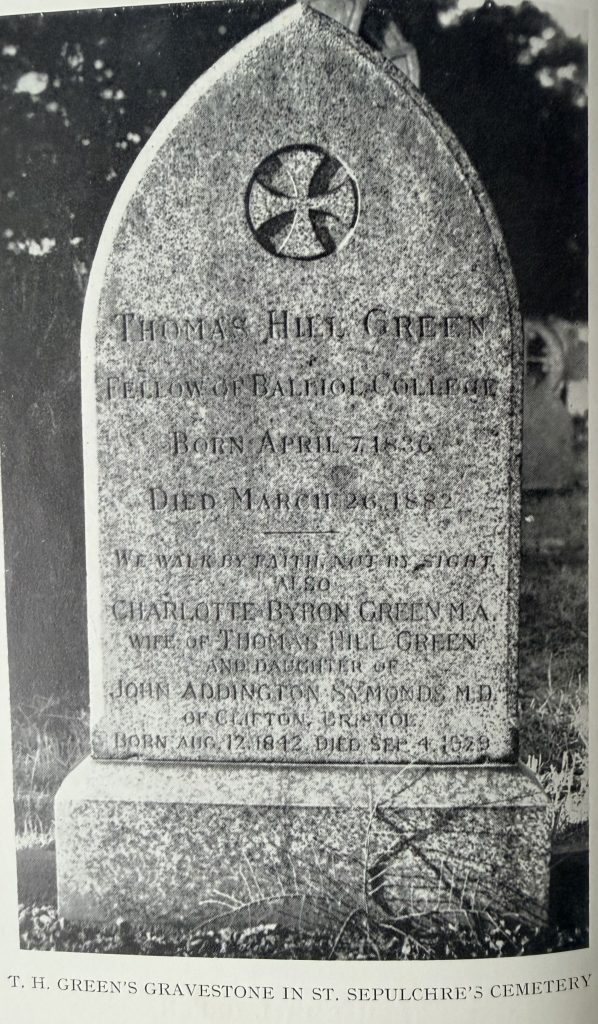
Nettleship’s Memoir gives the same picture of the love in which Green was held in his authentic story of the end. The ‘ Prolegomena to Ethics’ was within twenty pages or so of its completion. The new house which he had been building in the Banbury Road was just ready for occupation in March 1882. On the evening of March 15th he was suddenly taken ill and dangerous symptoms followed. On the night of March 25th he was told he could not live more than a few hours. He was taken by surprise, but without disquietude he thought of what things remained to be done – the payment of pupıl-teachers in a school of which he was the treasurer, and the publication of his book. ‘ He spoke to those about him of his belief in God and immortality, adding in a characteristic way that he did not know what the life beyond might be, ” if we did, we should walk by sight, not by faith “:
Among the legacies to be paid after the death of his wife were £1,000 to the University for a prize essay on some subject of moral philosophy, £1,000 to found a scholarship at the Oxford High School for Boys and £3,500 to Balliol College to be used in the first instance for the promotion of higher education in large towns. The University and City joined hands to mourn his loss and honour his memory… To the citizens of Oxtord he had specially endeared himself. “After spending an hour with him,” writes one of them, “I always felt I had come under the influence of a superior being and came away with a higher ideal of life… ‘by his power of taking trouble and his liberality both in money and time he had done more than any man in his generation to elevate and sweeten the tone of Oxford politics.”
“We shall never know a nobler man,” wrote another of his friends.
The memorial fund raised was chiefly to found another scholarship at the High School for Boys and probably there is no way in which he would have preferred to be remembered.
The house he never inhabited in Banbury Road has a doorway above which his initials may be seen. His widow, faithful to the memory of causes which he held most dear, concerned herselt with education and was a constant visitor to the Girls’ Central School of which she was a governor. She outlived him forty-seven years. She died on September 4th, 1929, and was buried in the same grave as her husband in St. Sepulchre’s Cemetery at the northern end of Walton Street.
F. C. Lay