From the CITY OF OXFORD HIGH SCHOOL MAGAZINE VoL. LII, iii JULY 1960 No. 169
After an unfortunate lapse of one year, the sixth and seventh forms decided once more to ‘ don the grease-paint’ and the result was the varied programme of entertainment which took place on three successive evenings at the end of last term.
The existing facilities in the hall are such that a full length play, involving elaborate changes of scenery, is difficult to produce and so it was decided to stage a show, as has been the custom in past years, under the title of ‘ The Forum Presents …’. Nevertheless it was generally felt that the programme should include something of intrinsic value and there were several suggestions as to what form this should take. The most appropriate seemed to be, that one of John Drinkwater’s plays should be staged as a token of respect to this famous old boy. Thus it was decided to attempt ‘X-0’ which, although written a few decades ago, contains a very real and topical message.
The stage crew managed as best they could with the debris for former shows and under the expert eye of C. M. Garland produced some very effective scenery, while stage-manager I. A. Shields efficiently organized the shifting. B. E. H. M. Heywood and J. W. J. Cronshaw played the Greeks, Pronax and Salvius, K. Moore and A. R. Lane the Trojans, Illus and Capys, and G. H. Brooks and J. E. Jarvis the sentry and servant respectively. Much of the credit for its smooth production must go to Mr H.E.Rexworthy who gave up much of his spare time during rehearsals.
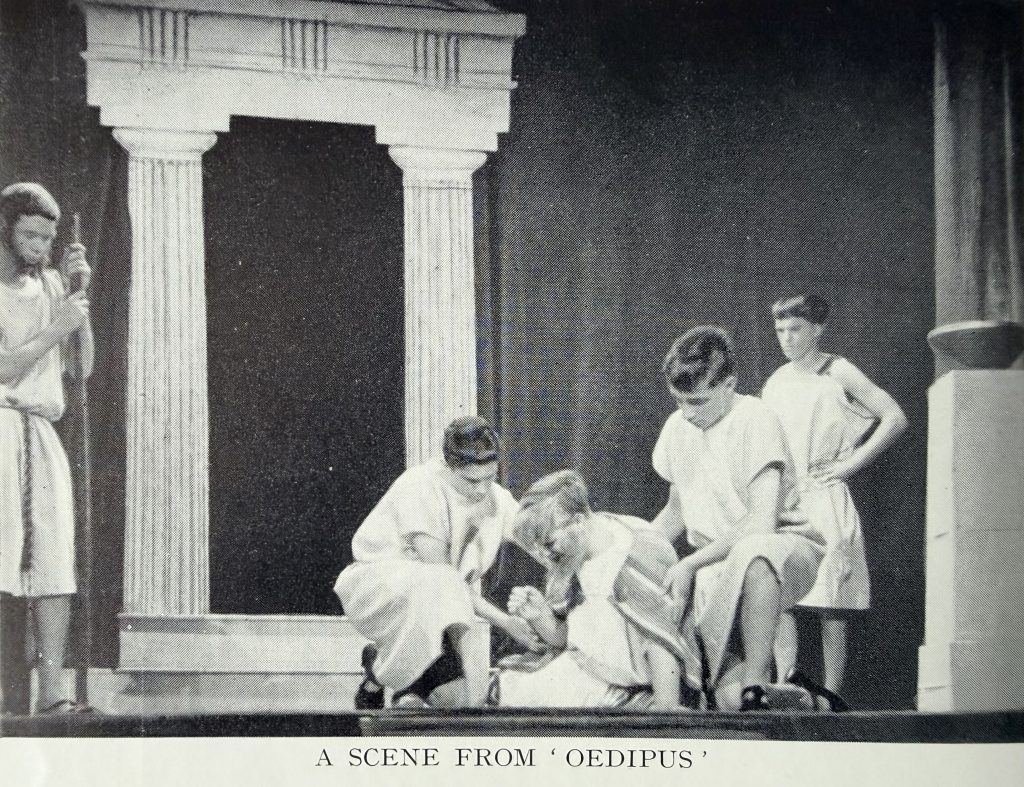
Early in the planning of the show the classical sixth expressed a desire to stage a classical tragedy and the last scene of Sophocles’ Oedipus Rex was attempted. This was produced by the Headmaster and despite the view of the local newspaper that the Project was over-ambitious, the audience each night acclaimed its success by their applause. M. J. H. Williams played Oedipus; P. Lynn, Creon; J. E. Griffin, the Chorus Leader; D. J. Whitton, a messenger; and the rest of the cast included D. Savage, R. C. Clarke, M. J. Beasley, B. G. Walker, A. F. Footner and C. T. and D. J. Hebden.
In the lighter vein there were several sketches which all went down well, albeit that they were rather slapstick in places. The C.O.S. Ballet Company’s version of the ‘Dance of the Flutes’ from the Nutcracker Suite proved the most popular, gaining two encores. P. Lynn and A. J. Williams danced the leading roles.
K. Murray’s sketch, telling the story of a ‘ not-too-familiar’ battle of the last war, was something of a novelty and the success of J. Downing’s photographic slides, was reward enough for cold and wet limbs during the ‘filming’.
R. F. Cousins, G. H. Brooks and J. E. Jarvis ” starred’ in a murder drama reminiscent of the early screen and K. Moore and P. Strongitharm staged quite an authentic western fight, the ‘Good’ rightly triumphing over the ‘Bad’.
The programme of sketches was concluded by the appearance of the hall and my a tainers ho alaended the entre neway Queen ‘ in which L. W. Davies somehow always managed to do the wrong thing. All the sketches were ably produced by Mr. A. R. Dixon.
Music, of course, also had its place in the show and the orchestra under the direction of Mr. Busby opened the evening with Sinfonietta (1st and 3rd movements) by Mozart. This was followed later by an item by a brass sextet and after the interval the male voice and the full choirs performed and P. Jarvis and D. Cozier played solos on clarinet and trumpet respectively.
In retrospect the cast all agree that they enjoyed themselves, and hope that the audiences did too. They would like once more to express their gratitude to the Headmaster, and Messrs. Rex-worthy, Dixon, Busby, Riley, Cumming, G. Wright, Allen and Johnson, not forgetting the refreshments committee ably led by Mrs. Davies, Mrs. Bodey and Mrs. Taylor.
K.M., VII.