From THE CITY OF OXFORD HIGH SCHOOL MAGAZINE Vol XLVIII,ii MARCH 1956 No 156
Ian (Spud) Taylor writes:
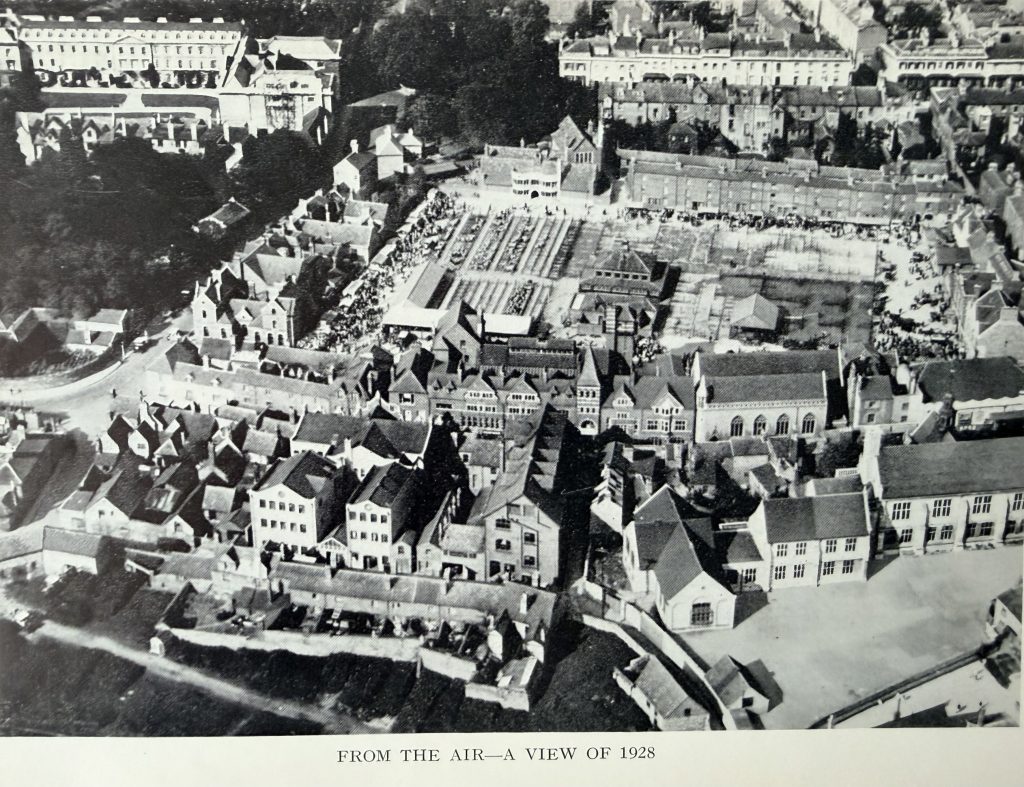
Seventy-five years ago [Ed. 1881] the original school building – the hall, the four rooms below, and the two staircases—was nearing completion. The site, then valued at £4,000 had been presented by the Corporation to the Governors with a like sum towards the building fund. Most of the remainder of the £10,000 which it cost to erect and furnish the School—was given by the University in its corporate capacity, or by the Colleges themselves, and by a number of individuals within the City and University. The new City of Oxford High School for Boys met an immediate need with marked success.
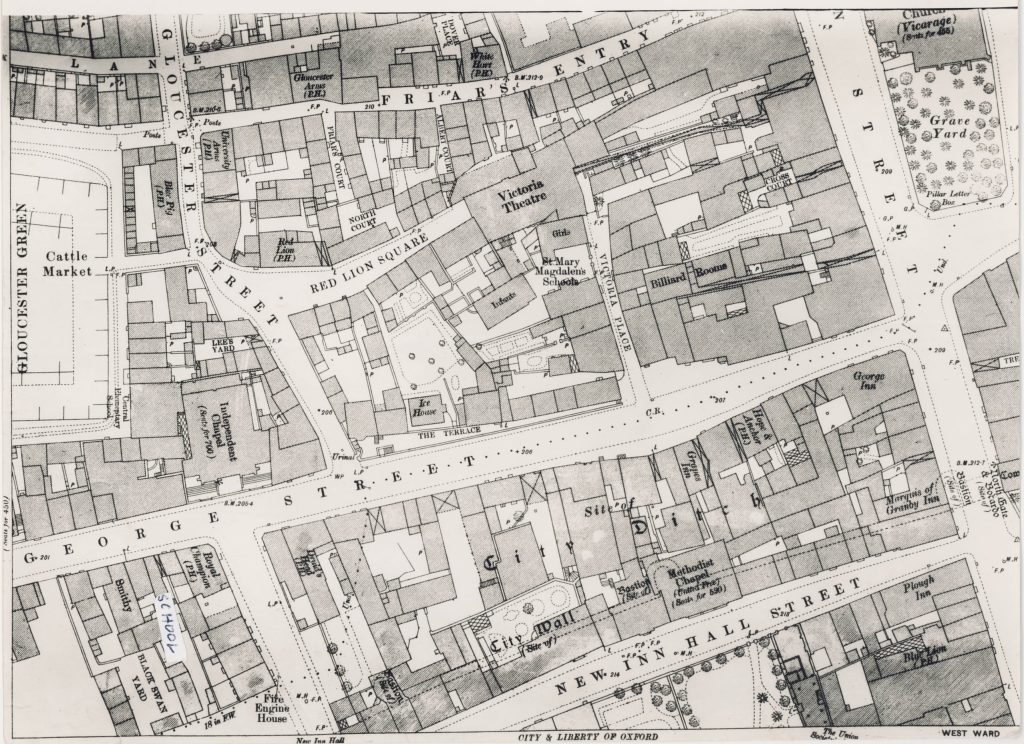
Starting with a small clear space near the present front gates, the demolition of six houses in George Street, a smithy, and eight or ten cottages behind in Black Swan Yard (where now stands the geography room) gave most of the present frontage. A further five cottages facing Bulwarks Lane and another adjoining the bastion were cleared to provide the playground; the rest was open garden. At one stage before building commenced it was urged that plot 51′ , the three shops with outbuildings nearest the front entrance, might be bought, but money did not run to this. When the physics laboratory was built in 1915 it was hoped to extend the room to the north, but the cottages concerned in Queen’s Court and George Street Place were only demolished about 1942. Five shops still remain separating the west wing from the bustle of George Street.
New Inn Hall Street was cut through the line of the city wall into George Street rather less than a century ago. At this time Nos. 25, 27, and 29 and the corner shop were built. The latter still bears traces of a brewers’ sign for it was the Royal Champion public house replacing an older building destroyed by the street. No. 25 has an interesting history: originally it was the headquarters of the Oxford Volunteer Fire Brigade, the ground floor being adapted to take the engine. In 1896 the Governors took the lease from the City for extra classrooms and a Porter’s residence. Four years ago it was demolished but the ground floor was rebuilt and the fire-engine plaque from the gable was entrusted to safe keeping. No. 27 was converted to Masters’ common rooms and a form-room, while the Porter moved to No. 29.
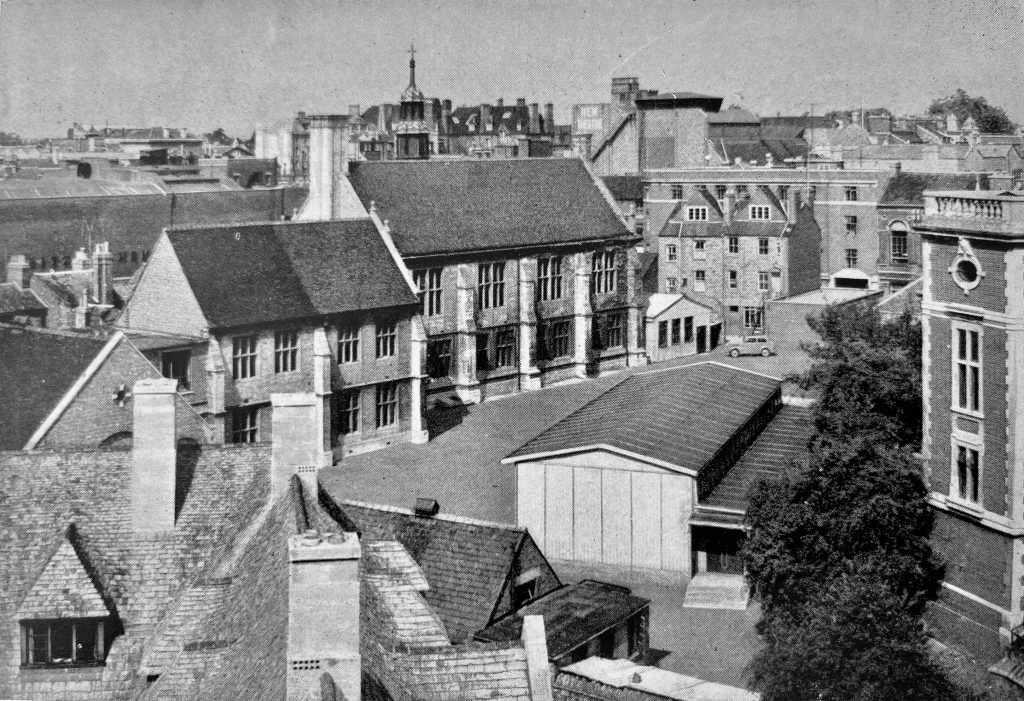
The School site is in three parishes: the main buildings and the northern half of the playground are in St. Mary Magdalen parish, most of the aluminium block is in St. Peter-le-Bailey parish, while the south-eastern portion is in the parish of St. Michael at the North Gate. The city wall which forms our southern boundary is now in the possession of St. Peter’s Hall and the Wesley Memorial Church. The bastion was conveyed back to the Corporațion in 1934. It is scheduled as an ancient monument, and as such is to be preserved from injury by government order.
The City’s original ownership of the site, as also of much other property in the vicinity, derives from two interesting sources. Oxford’s principal charter was granted in 1199, a few weeks after King John’s accession. By it the burgesses or freemen (that is, the members of the Gilds) gained all the considerable privileges of the citizens of London, including service at the coronation feast, and the ownership of the soil of the roads within the town, the city walls, the vacant strip of land within the walls, and the moat. The southern half of the playground is clearly on the site of the city ditch. One wonders whether some of the bones uncovered when the foundations of the new block were dug in 1950 represented domestic refuse of the past two or three centuries or butchers’ waste conveniently dumped in the pre-reformation fish-ponds along the line of the moat.
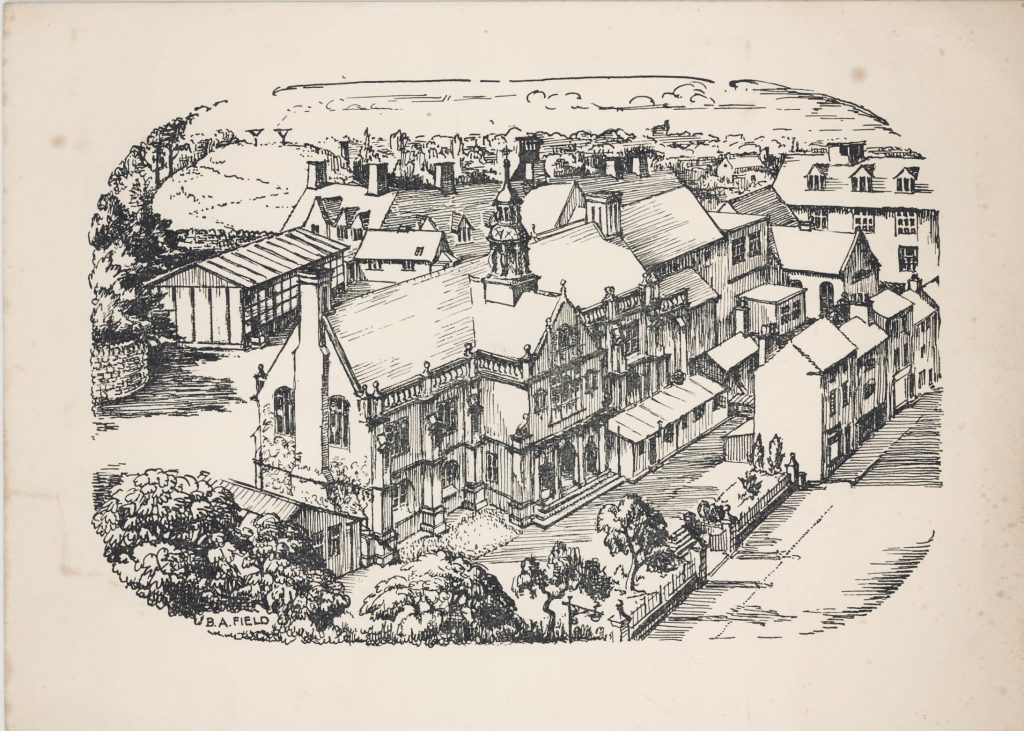
The land in the parish of St. Mary Magdalen to the north of the ditch, along the north side of ‘George Lane’ (“Brokenhays’), in Gloucester Green, and certain property in what is now Walton Street, being open or derelict, passed to the Corporation as the ‘ waste of the manor’ when in 1592 it purchased the Liberty of the Northgate Hundred from George Brome of Holton for £180. The income from the manorial courts became less and less but that from the land, especially in George Street, quickly increased with the rising demand for vacant plots. Most of the property is still in City possession and that given to the Governors in 1878 has reverted to the Corporation with the changed status of the School. Gloucester Green, besides housing the cattle market, was the site of the city gaol, the stones of which were offered for the new school. The offer was rejected in favour of the very happy combination of forest marble walling from Bladon and Clipsham stone dressings from Rutlandshire. No doubt the building is sound enough for centuries to come, but the eventual removal of the School will provide the Corporation with an extremely valuable site and a specimen of architectural composition and construction which it would be a shame to destroy.
I H Taylor