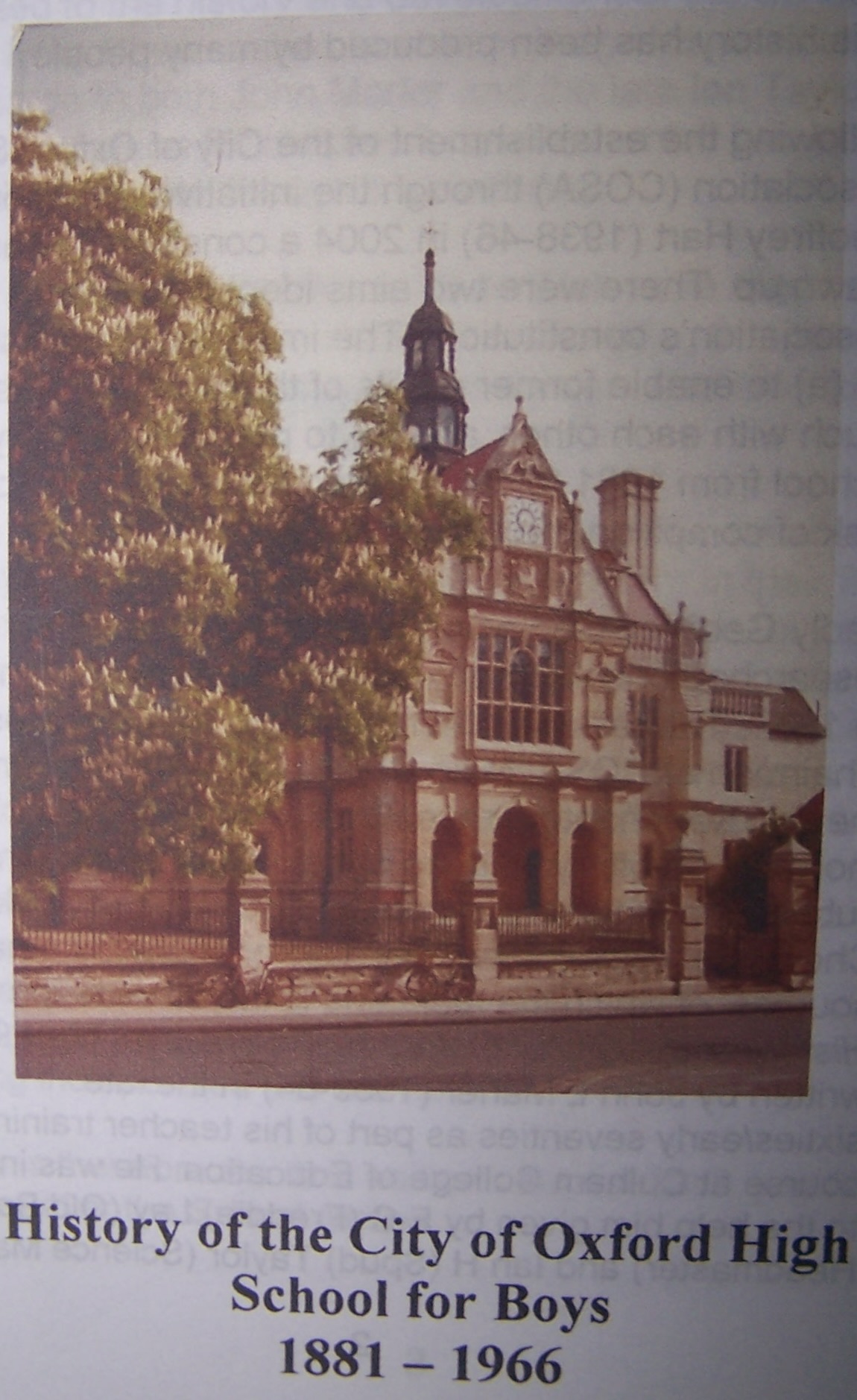
COSA Chairman Geoffrey Hart completed two Chapters of the History of the City of Oxford (High) School before his untimely death.
He began Chapter one by briefly outlining the beginnings of education for all children in Oxford.
“The one significant secular predecessor of our School was Nixon’s School, which survived from 1658 until it finally closed in 1875.
The Founder
At about this time Thomas Hill Green came upon the scene. He was charged by the government to make a thorough investigation of education in England and Wales. In1874 he joined the Oxford School Board, and in 1877 he became a member of the City of Oxford High School Committee, charged to explore the possibility of establishing a new secondary boys school in the city.
Green bemoaned the fact that local children did not have an opportunity to attempt to gain entry to the university in their own town. He put his money where his mouth was, and he and his two sisters made a number of endowments. He died in March 1882, only a few months after the School opened.
The Foundation Stone of the School was laid on 13 April 1880 by HRH Prince Leopold, Queen Victoria’s fourth and youngest son. He was created Duke of Albany on his marriage in 1881, but he was a haemophiliac and died in 1884.
A cavity beneath the Stone a bottle was laid which contained a copy of that day’s Times and several coins of the realm.
Laying the Foundation Stone
At the luncheon following the laying of the Foundation Stone Sir William Harcourt, a distinguished proponent of the School, took the opportunity to refute that the School would be a middle-class preserve (hear, hear).
“It is more than that. I hope it is intended to be a great stepping-stone between the poorer and wealthier classes of the community, and that those who by industry have so distinguished themselves in elementary classes may, taking advantage of this School, be able to rise to the University itself.” (cheers)
The aim of the School was to prepare boys for the world of commerce and public service, and the best for a university education.
The Architect
The building of the School necessitated the demolition of some two dozen dwellings. The site was made over to the Governors, but provision was made that if the School ceased to function the site would revert to the City Council. This happened about eighty years later in 1966.
The architect chosen for the project was Thomas Graham Jackson, later to be created a baronet in 1913. In 1876 Jackson had designed the Examination Schools, the Chapel in Hertford College and, among others, the Military College at Cowley, on the corner of Oxford Road and Hollow Way.
There was to be a Headmaster’s House and boarding facilities on site, but funds were inadequate, and the first Headmaster, Arthur Pollard, lived in Bradmoor Road and took in boarders there.
Forest Marble Stone from Bladon was used extensively, and the dressing stones were mainly from Clipsham in Rutland, a favoured source of stone for university buildings. Broseley tiles were used for the roof. The building contract was awarded to Charles Claridge of Banbury.
Financing
Right from the beginning there were financial constraints. Alderman Hughes paid personally for the clock. Jackson proposed the motto Nemo Repente Sapit. This was freely translated by later generations of boys as “Don’t rush us” or “No-one repents wisely”.