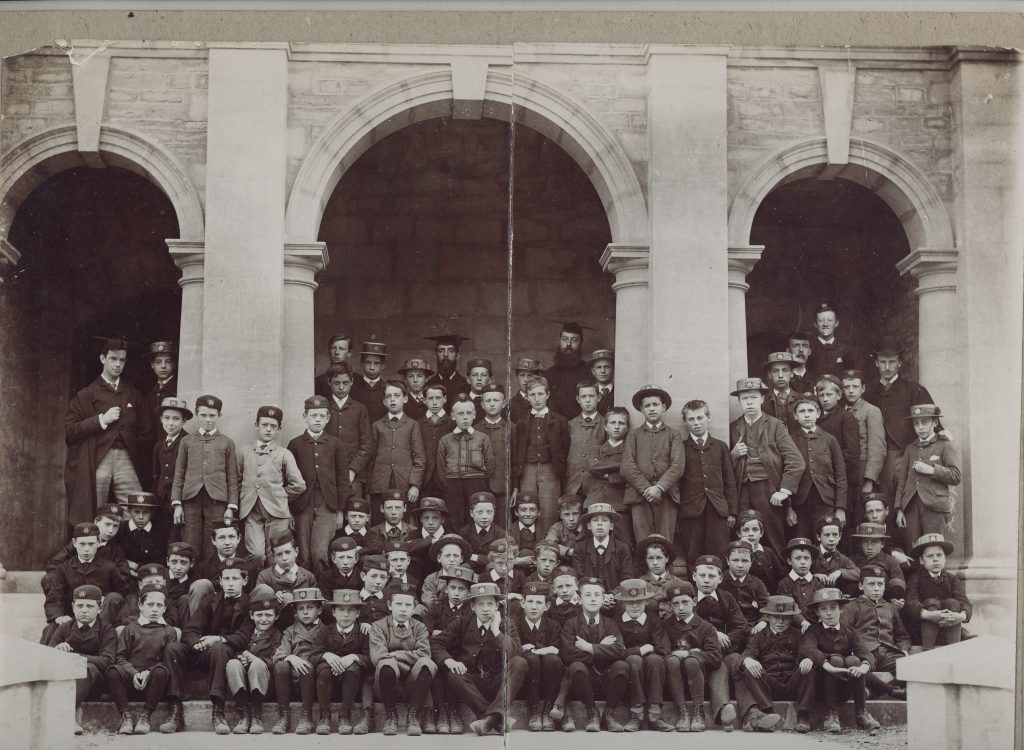
The perfect rag

by Brian Bowler (1944-1951)

Submitted by his contemporary, Alan Trinder

It was traditional at the High School for the sixth form boys to indulge in ‘rags’. These were more or less harmless pranks, outside of the school rules but generally tolerated by the staff as an expression of youthful high spirits. The year I was in the upper sixth we had had a series of rags particularly in the run up to the end of the school year (1951) and what was for some of us the end of school life. The most daring had been the suspension of a chamber pot from one of the main beams in the school hall.

Continue reading “The perfect rag”

The Early 1940s

by Ivan Mazonowicz (1940-46)

Ivan Mazonowicz (Mason since 1957) 1940-46 writes:

There were some fine teachers, eg Harry Jacques (Chemistry), ‘Pongo’ Bodey (Physics, who was my role model when I became a teacher, and ‘Tich’ Wright, among others. Some were not so fine. I vividly recall one pupil crying, on his hands and knees, being brutally kicked along a corridor by two of them.

I had two main interests – Chemistry and the ATC, and I took no part in any sports. I left with Higher School Certrificate in Chemistry, Physics and Zoology and a gliding certificate, courtesy of the ATC. On the same gliding course was Don Bennett who was caught one day by a freak gust of wind and landed his glider upside down. It frightened all of us present, but he emerged unharmed.

In form 5b my close friend was Desmond McCarthy. We talked much of our ambitions. His was to become a teacher, mine to fly with the RAF. I became a teacher, he became a navigator in the RAF – a short career. He was killed in 1958 when his Canberra crashed into a German mountainside.

On leaving in 1946 I worked as a lab assistant at the Pressed Steel Company, then at AERE Harwell until National Service struck. I spent two years as a private in the Duke of Cornwall Light Infantry – mostly in Somalia. Disliking this greatly, as soon as I was released I joined the RAFVR to ensure no further army service.

In 1953 I was commissioned into the Training Branch and served 19 years with the ATC until, having qualified in the meantime as a sailing instructor, became Lt RNR with the sea cadets. In 1974 a stroke ended my nautical career and later led to early retirement from teaching.

In 1950-52 I qualified a a teacher at Culham College, then taught in Oxford, Montreal and Dorset, taking early retirement in 1981 and devoting my time to travel and writing with modest success.

In 1954 I did the wisest thing of my life and married Joyce Tennant (ex-Central School. Our daughter Penny has two daughters, one a doctor and the other a vet. Our first son Robert died at 40 of childhood cancer, Our second son (PhD in Chemistry) teaches in Christchurch.

 In 2000 I had a second stroke which left me needing a wheelchair. This we manage to take to Spain twice a year. Otherwise Joyce and I lead quiet valetudinarian lives in Dorset.

Lawrence TV sequel 1990

In this made-for-television sequel to the film LAWRENCE OF ARABIA by David Lean, the legendary British officer T.E. Lawrence travels to the Paris Peace Conference with his comrade Emir Feisal, the King of Syria, to attempt to win independence for the Arabs.

Upon arrival, however, he finds backroom politics have become more treacherous than desert warfare due to the recent discovery of the Middle East’s vast oil reserves.

Ralph Fiennes plays Lawrence.

Cast & Crew:
Ralph Fiennes, Siddig El Fadil, Denis Quilley, Nicholas Jones, Roger Hammond directed by Christopher Menaul 

The WW2 Memorial

The school’s WWII Memorial is located in the Oxford Community School (previously the Oxford School, previously to that Southfield School and now the Spires Academy).

The Inscription reads: Grati Dulcem Colimus Memoriam Horum Huiusce Scholae Alumnorum Qui Pro Communi Omnium Libertate Vitam reddiderunt. MCMXXXIX – MCMXXXXV

The translation offered in the April 1966 Scvhool Magazine reads: “Gratefully we cherish the dear memory of those pupils of this scholl who for the general liberty of all men gave up their lives.”

Denis Tomlin offers the following alternative: “With thankful hearts we honour the cherished memory of those former pupils of this scholl who laid down their lives for the universal freedom of all men.”

The names of the 56 people remembered on the memorial are:

B C Adamson – H F Bannister – P L Bayzand – D H Beare – H M Beeson – M H Bullock – H T Burden – H D Buswell – J D Cox – A G Davies – R C France – W A Freeborn – R Griggs – S D J Grimsdale – J G Halliday – A F Hamilton – K C Hampson – S J Heath-Smith – R B Hester – D S Hill – K G Hill – J E Hills – P W Hine – T V Holbrow – K J Howes – H G Jarman – R Jennings – W G Johnstone – H R Keen – H A Kidd-May – C F King – E A Legrand – P J Lewis – W C Liebermann – P R Loose – J W Lynes – J N M Muir – J B T O’Neill – W J Pearce – R G Robbins – J A Rowley – H Sabarsky – H W J Savin – S M Seddon – E A Sims – H C Nichol Smith – I T Stanley – F W Taylor – J E Timms – J D Turner – J A R Ware – P A Watts – A W Webb – M D J Williams – C N Woodcock – CW Wright. 

An unknown pupil writes:

I was moved by the reference to the WWII memorial. Several of the men named on it were known to me. I was aware that one or two had been killed, but some others came as a shock. Even at this late date the thought of those young lives being lost is very saddening.

Among the names that I see is that of Jack Halliday, who was, I think, our last Cricket Blue (1935). When I joined the School he had just left, but he had obviously been a great sporting hero, and there was much talk of his getting a Blue, in which he was eventually successful in his second year.

Also among those lost is S J Heath-Smith (generally know at school as S J H Smith. My recollection is that he boxed for the university, though I am not sure whether it was before or during the war.

(Note from Ken Powell: There was a photo of S J H Smith in the school hall over the stage next to one of an eclipse! He boxed for Oxford before the war.)

One name missing is that of Dick (R S?) Withers. I have no certainty of his death, but I remember being told by Peter Quelch soon after the end of the war that he had been killed – I believe in an RAF bombing raid. He was a great chap, with whom I had much pleasure in collaborating on a Sixth Form magazine in the early days of the war.

“Journey’s End”

by Ron Baker (c.1949)

Ron Baker (c.1949) writes:

Further to Ted Bown’s reference to “Journey’s End”, the play was produced by George Wright and performed on 2nd to 5th February 1949. The cast:

Captain Hardy: Alan Stokes
Lieutenant Osborne John Robinson
Private Mason James Higgins
L/Cpl Broughton Maurice Croxon
2nd Lt Raleigh Howard Jones
Captain Stanhope Paul Groves
2nd Lt Trotter Michael Somerlad
2nd Lt Hibbert Alan Lower
Co Sgt Major Michael Tregoning/Keith Gibbons
German Soldier Maurice Croxon
The Colonel Ron Baker

Paul Groves, who had left School in 1947 to study at RADA, took over the part at short notice after P Wharton was injured during County Rugby Trials, and Keith Gibbons took over as CSM when Michael Tregoning became ill just before curtain up on the second night.

The School Caretaker, Mr Durham, was also involved behind the scenes, one of his duties being to make the “stage whisky” with cold tea.

Eugh! 

Ed. This production was written up in the school magazine here. Journey’s End is a 1928 play by R. C. Sherriff, set in Northern France towards the end of the First World War. It has often been produced, as it provides a glimpse of life in the trenches and is of a manageable size for performances by amateur societies. First performed at the Apollo Theatre in 9 December 1928, it starred a young Laurence Olivier. (Wikipedia)

A Memory of Mike Winters

by Derek Jeffs (1940s)

Derek Jeffs (1940s), at the School during the war, reminisces in the Oxford Mail about a disastrous night when he took part in a gig with the future comedian Mike Winters:

Mike Winters, whose real name was Mike Weinstein, was one of many evacuees who had come from London to Oxford. He later teamed up with Bernie Winters.

Four boys formed a quartet – Derek was on the double bass, Peter Payne on drums, John Beesley on piano and Mike Weinstein on clarinet.

“We mostly played in private in Peter Payne’s house, but on one occasion we were asked to do a professional gig.

Unfortunately the people who were there wanted to dance, and we didn’t have any dance music. Our music wasn’t what they wanted.” 

error: Content is protected !!