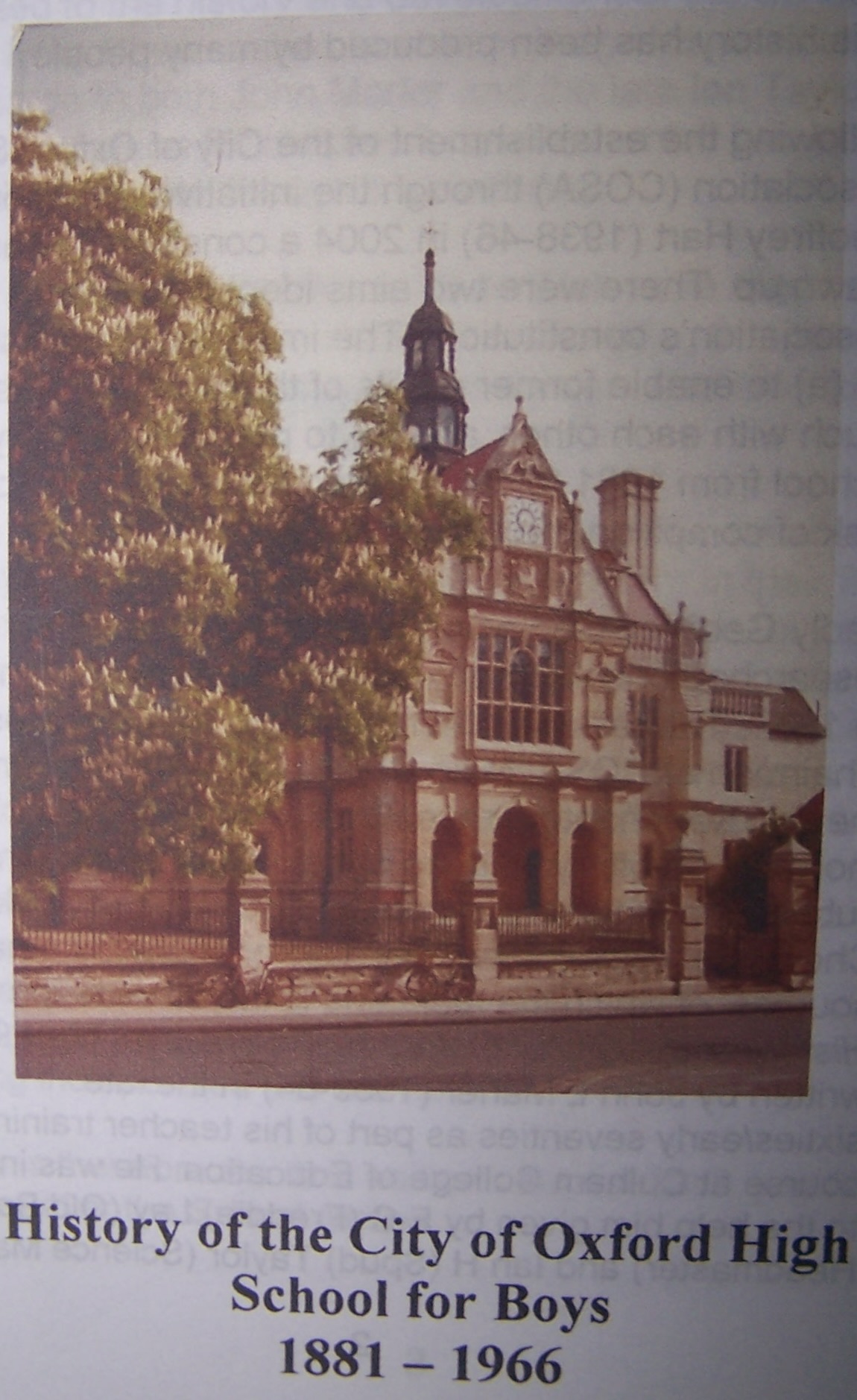
A T Pollard 1881 -1898

The Unfinished School History by Geoffrey Hart

Chapter 1: A Very Good Start – The Headmastership of A T Pollard

The following details on the History of the School are taken from the work of Geoffrey Hart (COSA’s first Chairman) just before he died. These cover the first years of our School until Mr Cave succeeded Mr Pollard as Headmaster.

The School opened in the autumn of 1881 with forty-six pupils with much ceremony. Many dignitaries of town, gown, county and church were present and continued celebrations with a banquet in the evening in the Town Hall.

The first headmaster was A T Pollard, He clearly did some of the teaching and there were five assistant masters, some of whom were part-time. One of the first intake, Henry Wilkins, later penned his impressions of the early days, and this appeared in the March 1924 edition of the School magazine.

The main income of the School came from fees at £4/10/- (pounds and shillings) per term. Over the next sixty years these were to rise less than fifty percent. Boys from poorer homes needed to win scholarships, of which there were few at that time, despite the promises of the town council to provide fifty free admission scholarships each year. 

In October 1881 Mr Pollard was given permission to take boarders at his house at a rate of £12 per term. The following year the Governors made provision for six admission scholarships for boys educated in public schools in the town. In the first year sixty boys from the town’s elementary schools sat the entrance examinations, so there was certainly a demand.

By 1882 the number of pupils had increased over 75% to eighty-one. The library now held 800 books. A field had been secured for football, two colleges made their cricket fields available for school use during the summer vacation. There was also a fives court and a gravelled tennis court.

The highest numbers achieved during the eighties were 115 in 1884, when the school was described as full, but then there was a decline to 96 in 1887. There was a consequent serious drop in income. There were promises of scholarships but few actually materialised.

During these early years academic successes were remarkable, both at school and university level. The School Register, covering the careers of those who were at the School between 1881 and 1925 showed, however, how much the School sought to fulfil the dual vision of the governors – academic success and social inclusivity. A survey of the Register shows a wide range of occupations of parents of the early intakes.

There were serious financial problems at this time. The estimate of £8,000 to build the School turned into an actual £10,000, and this debt plagued the School for a number of years. It was probably the reason why Headmaster Pollard stayed at the School for only six-and-a-half years. He later became Vice Master of Manchester Grammar School and finally Headmaster of the City of London School. An article written by him about his time at the School appeared some forty years later in the March 1928 edition of the school magazine.

Origins of school crest and mottoes

The following text is taken from a School magazine where popular teacher Ian (Spud) Taylor explained the origins of the School Crest and Mottoes. Some text and several images are missing – which lacunae we hope to repair soon:

“Oxford High School was from its foundation the City School. The Corporation gave the land and the sum of f4,000: the rest of the cost of §10,000 for the original building (the hall, the four rooms beneath, and the two staircases) was borne by the University, various Colleges, and numerous well-wishers both within and without the University.

Continue reading “Origins of school crest and mottoes”
error: Content is protected !!