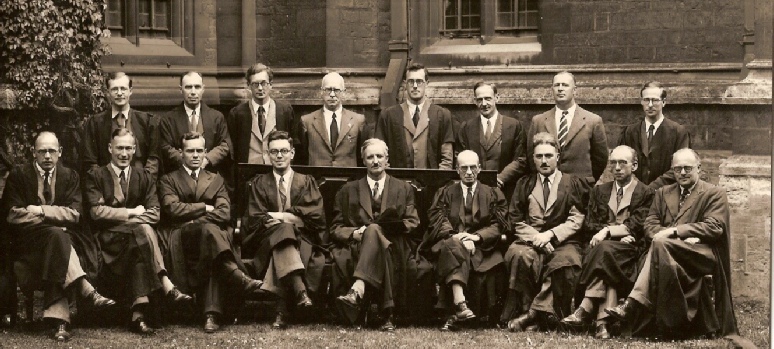
The Headmasters

The headmaster’s chair
Continue reading “The Staff Gallery”The story of a successful town and gown project
Writer known:
“Mr Badham, Headmaster during my time at School, rarely gets a mention in the Newsletters. He was the only man I ever met who regularly wore spats. He enjoyed quoting, in his slightly old-fashioned accent. “Joshua, the son of Nun, and Caleb, the son of Jephunneh were the only two who ever got through to the land of milk and honey,”
Mr Atkinson, Classics master, had a “thing” about the application of the birth qualifications for international Rugby. He would often interrupt a lesson by turning on a boy and asking him if he had a Scottish grandmother; and if the answer was “Yes.” He would say triumphally “Then you can play rugby for Scotland.”
Tich Wright was an elegant batsman who sometimes turned out for the School in matches against non-School (as did Sam King, the groundsman).
Mr Masters was always known as “Kitty” after a dance band vocalist popular on the radio.
Mr Searson was the Geography master and form master of Remove (form room, at least in my time, the first in the row of huts inside the New Inn Hall gate entrance and opposite the tuck shop). In 1933, when I was in his form, he used to organise unofficial boxing contests in the space at the front of the form room. I have no idea whether they took place in other years. (Ed: I remember boxing there against Tony Patterson. I won because he was even smaller that I was at that time, and he even more scared than me.) He also played a part in organising the annual outings of the School Geographical Society. I remember interesting trips to the Cadbury factory at Bournville, Morland’s match factory in (?) Gloucester, and the Imperial Institute in London.”
Stephen Peters writes:
“Further to the remarks of Colin Justin and Nigel Moulden about “Flea” Lee, another of his punishment options was to be beaten with a broken chair leg (wooden). What luxury to be able to choose between the metal pipe, the length of rubber and the chair leg!!
It is of little comfort now to know that he and several other masters of the period 1956-64 would these days be imprisoned for child abuse – and not all of it physical abuse.
Like John Geach, my (too many) years at COHS were far from the happiest of my life – though I do cherish the memory of several sympathetic teachers, particularly “Eddie” Swire, the musical Busby and “Titch” Wright.
Too many members of staff, though they may have had a knowledge of their subject were, as far as teaching it was concerned, way beyond incompetent. It is not surprising that in the post war years there were so many dropping out before University as several correspondents have mentioned.
Philip K Swire retired in July 1977 after 34 years at the City of Oxford School and Oxford School.
He was educated at Glossop Grammar School and Wrexham county School before coming up to Jesus College to read Modern Languages.
For three years he was in Launceston, Cornwall before moving to Oxford in 1943.
It seems that Oxford suited him, for he seems not to have contemplated moving on again. He clearly enjoyed the bookshops and record shops in and around St George’s Street.
He encouraged many to develop an interest in opera, ballet, films and literature. Those who knew him well were assured of good conversation, wine and music.
Philip E Nash died in 1968 from heart trouble, which had caused him to retire early from Denstone College in 1967.
An Open Scholar of University College he came from Ambleside in 1938 to replace Mr G E Churchill as Senior Classical Master. He was an inspirational teacher with a special interest in rugger and athletics.
After he returned from 4½ yrs service in the RAF with the rank of Flt Lt, his meticulous care for detail was shown in the productions of “Glorious Gallows” in December 1946 and Dorothy Sayers’ “Zeal of the House” in Dec 1947.
He left at the end of that term.
Laurie Bates, apparently an Old Boy but of whom we have no record, wonders why no mention is made of Mr Waterman, who was a Latin Master at the School. Anyone remember him?
Laurie, incidentally, lives in Paignton. Anyone remember him?
PS – A few hours after this item was placed on the website, we heard that Mr Waterman in fact taught English at the School in the thirties for a short while, and was by all accounts a brilliant teacher.
The information has come originally from Ted Painting, one of our senior Old Boys, who was at the School during that period.
B C (Ben) Atkin died in 1966.
He retired from the School after a bout of ill health, and lived in Iffley, near the parish church.
He was a Scholar of Hertford, and joined the School in 1932 as Senior Mathematics Master but left two years later for Beaumont College.
In 1941 he returned gave enthusiastic assistance as a Flying Officer to the No 1250 (Oxford Schools) Squadron ATC.
He also helped with rugger refereeing, but was best known as a noted mathematics scholar and teacher.
Mr A V Kiley taught Metalwork for some years at the School until leaving in 1966 was appointed Headmaster of an Infant and Junior School in Rochester in 1970.
Brian Gumm (1940-45) writes:
Looking back over some sixty years or more, my recollection of the COHS in war time was surprise that the process of education proceeded in a more or less orderly fashion with few interruptions due to the war raging across Europe. This I am sure was not the case, but through the eyes of a schoolboy it was the usual round of lessons, homework etc relieved by some of the exciting things going on around us.
Continue reading “COHS in Wartime 1940-45”John Stockford of Redwood City, California writes:
“Thanks for the Update …all very interesting.
Continue reading “Harry Jacques”