March 1908
“There was a young fellow from Perth,
Who was born on the day of his birth.
He was married, they say,
On his wife’s wedding day,
And he died on his last day on earth.”
Was this the original limerick on this topic?
The story of a successful town and gown project
March 1908
“There was a young fellow from Perth,
Who was born on the day of his birth.
He was married, they say,
On his wife’s wedding day,
And he died on his last day on earth.”
Was this the original limerick on this topic?
December 1922 – Editorial of the School Magazine
“Certain people are now demanding that all children shall have a ‘secondary’ education, and this, without considering the cost or the advantage [sic] to the nation.
For our part we cannot see how this is to be done, unless the whole system of elementary education is changed, and all the schools in the country are put on a dead level. We hope the ‘German’ methods are not going to find supporters amongst responsible politicians.
There is a very broad and easily climbed ladder already, by which any boy may gain as much as he desires, let us leave matters alone now for another decade or two before we change.
This restless age no sooner gets a scheme built up. Then there comes a desire to pull it all down and build something else before the scheme is fairly tried.”
July 1932
In the Old Boys’ section of the school magazine of July 1932 it is announced that the Old Boys have formed a Machine-Gun Platoon in conjunction with the Machine-Gun Company of the 4th Bn. Oxf. and Bucks Lt Infantry.
by ADC (Passed by Censor)
This is a personal indulgence by Mike Chew who read the article – of which this passage is just the beginning – in the Oxford High School Magazine of December 1916. He left it to others to react in their own way.
September 27th 1916
I had the greatest day of my life the day before yesterday when we went over the top.
Continue reading “Experiences in France in 1916”The numbers of Old Boys serving in the 1st World War – or the Great War as it was known then – was 580. In a school with a nominal intake of 120 pupils per annum that is a huge percentage:
Royal Navy 29
Royal Marines 3
Army 491
Royal Air Force 57
Sir Henry Sessions Souttar (1875 -1964) was an eminent surgeon. One of his books, “A Surgeon in Belgium”, dealt with his experiences in the First World War. It was first published in 1915 by Edward Arnold and is still available in a recent reprint (ISBN: 1428054154). Souttar became famous for his “Hole in the Heart” surgery, and later became President of The British Medical Association.
On the Barts & London Hospital website it is written:
“Sir Henry Souttar was another of The London’s most brilliant surgeons. He was the first surgeon in the world to open a chamber of the heart to stretch the organ’s mitral valve, which later became a basis for modern heart surgery. Sir Souttar also met Madame Marie Curie in Paris to discuss the use of radium, and then persuaded the Medical Research Council to give The London the first precious gram of radium which he used to treat breast cancer.”
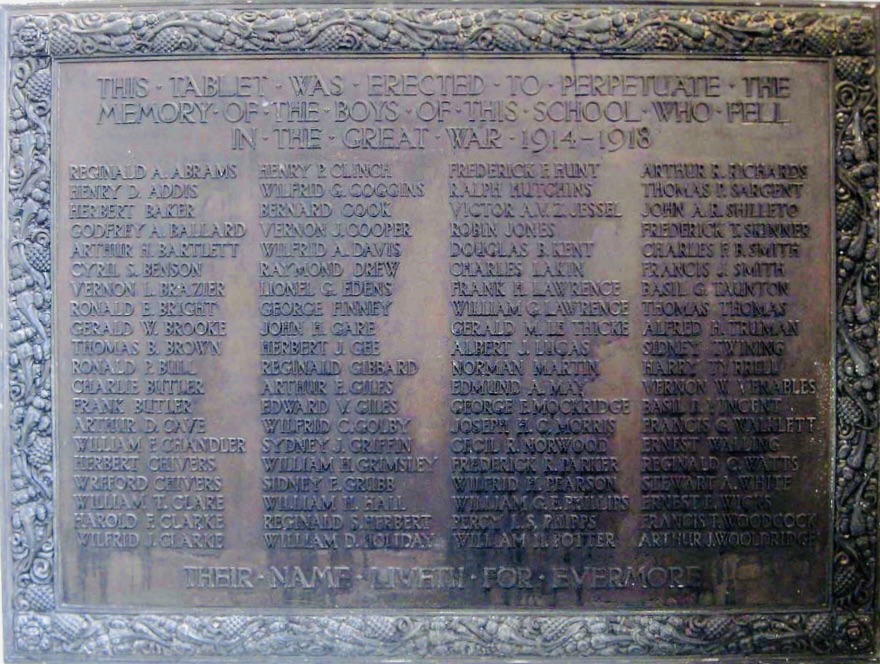
The transcript below is of a talk was given by Professor Adrian Gregory, the guest speaker at the COSA Annual Luncheon of 2017. It is a comprehensive review of the participation of Old Boys and Staff in the First World War.
‘Since 2014 I have been director of a research network at the university dedicated to ‘Globalizing and Localizing’ the Great War which is based in the Oxford University History Faculty housed in the Old Boys School building on George Street.
At some point in 2015 I noticed properly for the first time that the School Roll of Service was still hanging on the wall by the main staircase in the building and I started thinking about its significance. In early 2017. I teamed up with the brilliant local historian Liz Woolley (who unfortunately can’t be here today- and who lives literally just down the road in Grandpont) to begin exploring and analysing the Roll.
Continue reading “The School Roll of Service 1914-18”A Speech by Mr Churchill
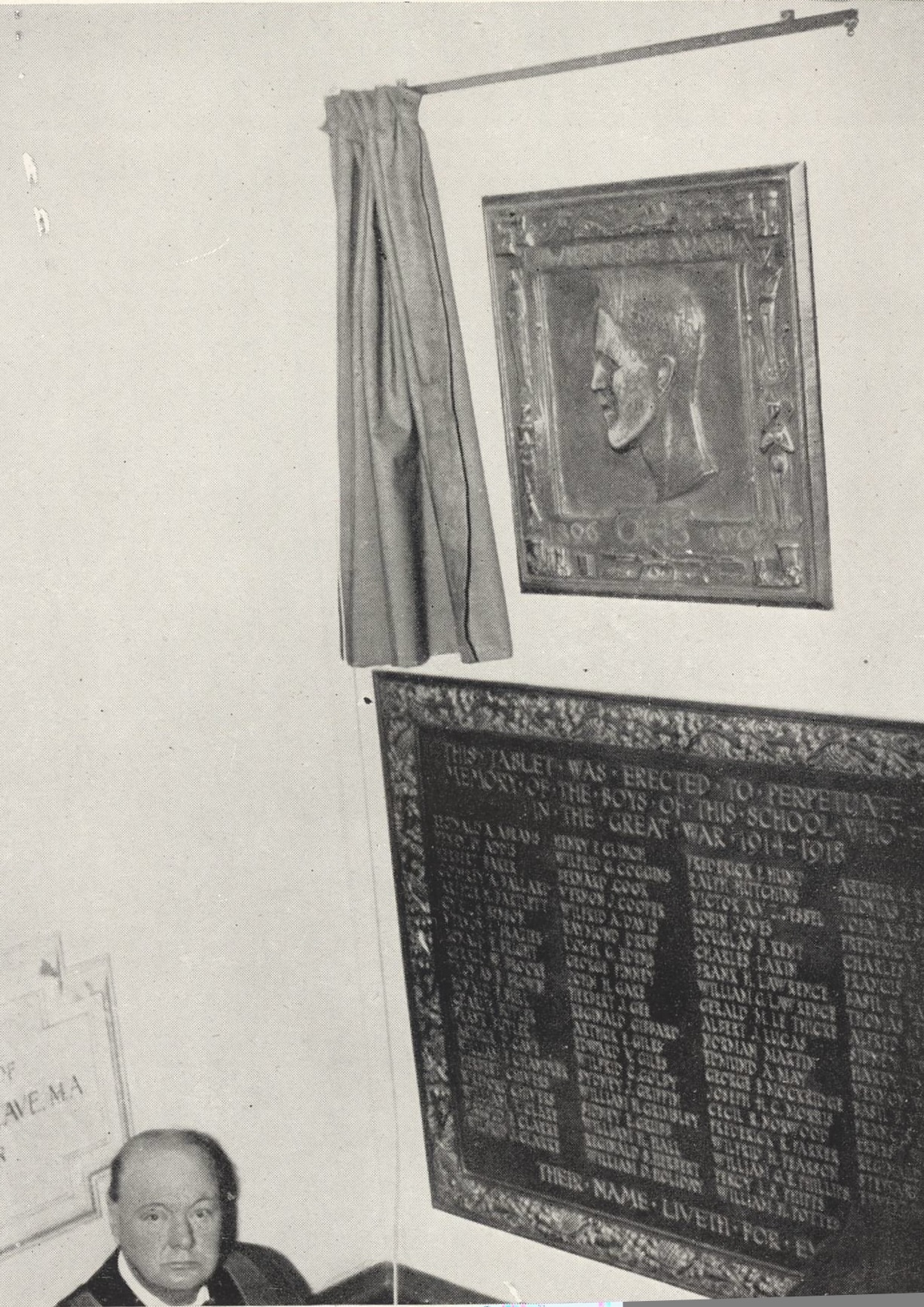
If you have not landed here from that page, you can read about the circumstances of this speech here
“Mr. President: Although more than year has passed since Lawrence was taken from us, the impression of his personality remains living and vivid upon the minds of his friends, and the sense of his loss is in no way dimmed among his countrymen. All feel the poorer that he has gone from us. In these days dangers and difficulties gather upon Britain and her Empire, and we are also conscious of a lack of outstanding figures with which to overcome them. Here was a man in whom there existed not only an immense capacity for service, but that touch of genius which every one recognises and no one can define. Whether in his great period of adventure and command or in those later years of self-suppression and self-imposed eclipse, he always reigned over those with whom he came in contact. They felt themselves in the presence of an extraordinary being. They felt that his latent reserves of force and willpower were beyond measurement. If he roused himself to action, who should say what crisis he could not surmount or quell? If things were going very badly how glad one would be to see him come round the corner.
Continue reading “T E Lawrence (1896-1907)”The Unfinished School History by Geoffrey Hart
Chapter 1: A Very Good Start – The Headmastership of A T Pollard
The following details on the History of the School are taken from the work of Geoffrey Hart (COSA’s first Chairman) just before he died. These cover the first years of our School until Mr Cave succeeded Mr Pollard as Headmaster.
The School opened in the autumn of 1881 with forty-six pupils with much ceremony. Many dignitaries of town, gown, county and church were present and continued celebrations with a banquet in the evening in the Town Hall.
The first headmaster was A T Pollard, He clearly did some of the teaching and there were five assistant masters, some of whom were part-time. One of the first intake, Henry Wilkins, later penned his impressions of the early days, and this appeared in the March 1924 edition of the School magazine.
The main income of the School came from fees at £4/10/- (pounds and shillings) per term. Over the next sixty years these were to rise less than fifty percent. Boys from poorer homes needed to win scholarships, of which there were few at that time, despite the promises of the town council to provide fifty free admission scholarships each year.
In October 1881 Mr Pollard was given permission to take boarders at his house at a rate of £12 per term. The following year the Governors made provision for six admission scholarships for boys educated in public schools in the town. In the first year sixty boys from the town’s elementary schools sat the entrance examinations, so there was certainly a demand.
By 1882 the number of pupils had increased over 75% to eighty-one. The library now held 800 books. A field had been secured for football, two colleges made their cricket fields available for school use during the summer vacation. There was also a fives court and a gravelled tennis court.
The highest numbers achieved during the eighties were 115 in 1884, when the school was described as full, but then there was a decline to 96 in 1887. There was a consequent serious drop in income. There were promises of scholarships but few actually materialised.
During these early years academic successes were remarkable, both at school and university level. The School Register, covering the careers of those who were at the School between 1881 and 1925 showed, however, how much the School sought to fulfil the dual vision of the governors – academic success and social inclusivity. A survey of the Register shows a wide range of occupations of parents of the early intakes.
There were serious financial problems at this time. The estimate of £8,000 to build the School turned into an actual £10,000, and this debt plagued the School for a number of years. It was probably the reason why Headmaster Pollard stayed at the School for only six-and-a-half years. He later became Vice Master of Manchester Grammar School and finally Headmaster of the City of London School. An article written by him about his time at the School appeared some forty years later in the March 1928 edition of the school magazine.